
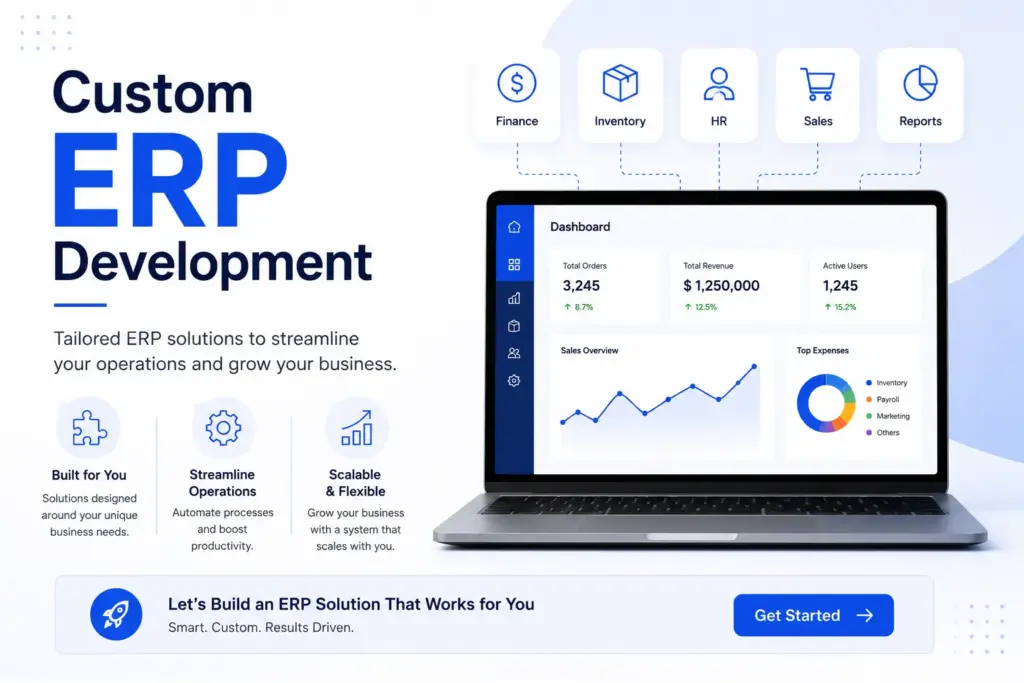
Almost every scaling company runs into the same wall at some point in time. Spreadsheets stop cutting it. Disconnected tools and systems no longer communicate with each other. Your finance team is working from one set of data, your inventory team is working from another, and No one has a clear, real-time view of the business. This is normally when organizations begin to truly consider custom ERP development.
This is exactly what off-the-shelf ERP systems promise to address. They also have real drawbacks, inflexible workflows, functions you don’t need and gaps where your unique processes simply do not fit. More companies in 2026 are implementing custom solutions instead of pushing their businesses to conform to the configuration of generic software and that is why. In this guide, we explain what custom ERP development is really about, why it matters to your business, and how to select the best partner for the process.
What Is Custom ERP Development?
Let’s start with the basics. Custom ERP development is the process of developing an Enterprise Resource Planning system that is tailored to the unique workflows, departments, and operational needs of a business along with its operational needs than following a generic pre-built ERP platform and making it fit.
Off the shelf ERP Software is designed to serve the greatest number of businesses, thus they tend to be built around typical or average scenarios. That is acceptable for some companies. However, if you run your business differently, have complex manufacturing workflows, niche inventory tracking needs, or unique compliance requirements for your industry, a generic system most likely will make you adapt your business processes to the software or pay exorbitant fees for customizations that end up costing way more and still don’t entirely fit.
In contrast, a bespoke ERP platform is designed in accordance with the way that your company operates. Combining your finance, inventory, HR, sales and operations data into a single connected system built for how you really work not how some “standard” business thinks you should.
Why Companies Are Leaving Generic ERP Behind
You should learn why this is changing, because it’s not just a trend, it’s combating legitimate annoyances which have been every so often felt.
Standard ERP platforms may provide historically large footprints of features that nearly all businesses never use, while lacking the critical functionality that truly drives their operations. They can be costly to license, slow to configure and downright inflexible when you want/need to pivot quickly. And since they are built for a larger audience, updates and changes take place per the vendor’s timeline instead of yours.
It’s typically at this stage where businesses start exploring custom ERP software development solutions to design and tailor their own process around instead of working to fit the mold of existing ones. This is the difference between “make it work”, and the new, improved: “built to work” and for most businesses this makes all of the difference between an ERP that actually helps do something as opposed to making yet more layers of frustration.
Advantages Of Custom ERP Development
This is why a custom system with specific integrations might not be a question of need purely for the sake of it, but rather something that makes business sense. Let’s break it down.
1. A Perfect Fit for Your Workflows
Unlike generic ERP software, custom ERP development that forces you to adapt your business, custom ERP development is built around existing business processes, or how you want them to work as you scale. No workaround logic, no manual patching and a system that actually helps your team instead of hindering them.
2. Better Integration Across Departments
Arguably the top benefit of a solid ERP will be in breaking down data silos. A bespoke solution can integrate the finance, inventory, HR, sales and customer service into a single source of truth, providing leadership with real visibility to what is actually happening across the business.
3. Scalability Built for Your Growth
Limitation on Growth Generic systems tend to become unsuitable as companies replace old software, or expand their business. An architected custom ERP works to match the type of growth planning you have, and therefore it will scale with you rather than face a painful migration later down the line.
4. Improved Data Security and Control
ERP systems store some of the most sensitive data a business has such as financials, employee records, customer information and operational details. For industries that are heavily regulated, custom development provides you with much higher levels of control over how the data is stored, accessed and protected.
5. Long-Term Cost Efficiency
While custom ERP development usually requires a higher upfront investment than a generic subscription from the outset. However in time, businesses realize that these make a significant savings between not having to pay ongoing licensing costs, customisation requests costing eye-watering amounts per day, and the productivity losses associated with adapting to working around a system which is just not right.
Competitive Advantage
A purpose built system around your operations can really take how you run to the next level versus competitors using just generic platforms like everybody else in their industry.
5 Common Use Cases For Custom ERP Systems
To add some tangibility, here are the areas where organizations are gaining actual value from tailored ERP development.
- Manufacturing — Tailored systems that revolve around specific production workflows, equipment asset tracking and supply chain management, which generic platforms fail to support.
- Retail and distribution — Inventory and order management systems that are designed for certain product types, warehouse configurations, or multi-location operations.
- Healthcare — ERP systems that are designed from the ground up for stringent compliance and data privacy requirements, not patched on top.
- Professional services—One-off systems that bring together project management, billing, and resource allocation formulas poorly manage on generic ERP platforms.
- Logistics and supply chain — Solutions for real-time tracking, route optimization, and inventory created around a business’ individual operational footprint.
These isn’t just a hypothetical you, these are the sorts of operational headaches that drive businesses toward its own custom-built pieces instead of dealing with patchwork of generic software.
Things to Think About Before Starting a Custom ERP Project
Now, there are a few factors you have to consider before going with the development.
Mapping Your Current Processes
Before you build anything, make sure that you have a clear view on how your business truly works — the good and the bad. It helps your development partner realize what should be preserved, what needs to be improved and where automation might really help.
Defining Core Modules First
I know it can be tempting to try and get everything in place at one time; however, that typically slows down delivery of the final product and makes for much larger costs. The right ERP development companies understand that implementing the modules that are essential for a quick launch, along with a strategy to iteratively add functionality, should be your focus.
Planning for Integration
Your ERP system is probably required to integrate with your existing tools, whether that be accounting software, CRMs, e-commerce platforms or industry-specific tools you rely on. Plan for integration, from day one
Data Migration Strategy
Particularly if you are switching from an existing system, or simply a jumble of spreadsheets, be sure to allow for the time (and effort) needed and make migrating that data accurate & secure.
Employee Training and Adoption
There is no such thing as a perfectly built system if your team never uses it properly. Prepare & transition plan. This includes training and handling of the transition period when all employees will be using the new system instead of the old process.
Everything Larger Organizations Should Know About Enterprise ERP Development
Enterprise ERP development for a larger simple business is already layered with complexities that a smaller business wouldn’t normally have to deal with.
Enterprise projects may require simultaneous support for many departments, locations, or business units, each with their own workflows and permission requirements. They also operate under tighter compliance requirements, larger data volumes and complex integration with existing enterprise software already in place throughout the rest of the organization.
Experienced project management is very key here. The enterprise ERP build process tends to involve more stakeholders, longer timeline and some level of care in change management to help facilitate a large team buy-in. This is a complication that can send projects spinning out of control, but a development partner with real enterprise experience understands how to navigate it.
ERP Development Company: How to Select a Reliable One
When so much is at stake, this is how to evaluate prospective mates.
- Relevant industry experience. Try to find a company that built ERP systems for businesses similar to yours, or at the very least, understand the logistics – if applicable of your industry.
- Strong architecture and integration skills. It is especially important to ask about system architecture, security around your data, and how they work with any existing tools you use.
- A clear, collaborative process. You need to know what happens at each stage of the project, and this team needs you to continually contribute input, not disappear for months on end.
- Post-launch support. An ERP system needs continuous maintenance, updates and at times troubleshooting. Search for a partner that provides support long after the initial go-live.
- Transparent pricing and timelines. Given that custom ERP projects are such a big investment item, transparent and realistic communication around costs and deadlines is critical right from the beginning.
Why Custom ERP Development with the Codiotic Is a Great Choice
This is what we’ll say frankly, as it honestly sums up the way in which the team tackles these projects.
About CodioticCodiotic is a New-age AI & Custom Software Development Company in India, and we allow businesses to build innovative, scalable & future-ready Digital Products. It combines advanced technologies with real industry expertise to develop applications, enterprize sofware, web platform & systems and mobile apps as well as cloud-based systems that can resolve business complexities ranging from AI-powered applications.
Codiotic is an ERP development company that prioritizes analyzing the genuine underlying problem your business is experiencing before making architectural or design decisions. From custom ERP software for a mid-size company in pursuit of efficiency to large-scale enterprise ERPs for organizations with numerous departments and complex integration requirements, the process is essentially the same, design a secure, scalable, authentic system that reflects how the company truly works.
The team consists of experienced professionals dwelling in ERP software development and further AI expertise using which custom ERP systems can come with intelligent automation, predictive analytics, and smarter reporting capabilities as companies expand. This mix of technical depth in ERP-specific builds and AI capability represents much of what makes this startup different from a more narrowly focused development providers.
Questions to Ask Before You Take the Plunge
The Core Questions: Go through this checklist before onboarding any ERP development partner.
- How many ERP systems have you built for businesses like mine with the same level of operational complexity?
- How do you migrate data from existing systems or spreadsheets?
- Walk me through your 3-step process of how you plan to integrate with tools we already know?
- What industry-specific security and compliance requirements do you both meet and address?
- What do your post-launch support and maintenance services look like?
- How will you engage our team during the entire development process?
Well defined answers are a good indication that the company truly understands the intricacies involved in custom ERP development. Response which are vague, or too generic, in nature should typically be treated as a warning sign.
Final Thoughts
This is why custom ERP development does require quite a large upfront investment, but when compared to how businesses that have outgrown generic software or disconnected spreadsheets in the past will benefit from this process, it should be one of the most impactful decisions your business ever makes. Not only does a new system organize your data, it also empowers your team with the tools and visibility they need to make quicker, better decisions throughout the enterprise.
Your evaluation process should be multi-faceted, take your time, don’t hesitate to ask very detailed questions regarding their entire system or rolling out just core modules in phases before turning into a fully-fledged system. A partner with the right perspective will embrace that method, because they understand that long-term success is built on a solid foundation.
Frequently Asked Questions
1. What is the usual cost of developing custom ERP?
The prices vary widely based on your operations complexity, the size of modules required along with integration needs. A phased approach, beginning with a few core modules can control costs and deliver real value early on.
2. As simple as it sounds, you may need to ask yourself How much time do we take to build a custom ERP system?
Timelines are determined by the scope; an initial rollout with a limited scope could take months whereas a large enterprise system might be rolled out over one year or more. By focusing on certain priority modules, organizations may see value sooner while the entire system continues to evolve.
3. How custom ERP software is different from off-the-shelf ERP platforms?
Custom ERP software is tailored directly to the unique workflows and requirements of your business, making it a better fit, and historically far more flexible with future growth needs. While the initial setup for off-the-shelf platforms is quicker, these packages are generic one-size-fits-all functionality which usually requires businesses to bend and contort their processes.
4. Simply put, is custom ERP development only for big corporations?
Not at all. So if enterprise ERP development is a different kettle of fish altogether when it comes to large organizations, even mid-size or smaller business with specific operational demands can easily find you fit with a custom-built platform better than generic systems particularly when the generic stuff just doesn’t gell well enough.
5. What are the reasons to think of Codiotic for ERP development?
Codiotic has years of ERP development experience and a plethora of software and AI capabilities allowing your system to be more than just useful but rather scalable so that it can continually grow alongside your business. Skip generic, one-size-fits-all solutions the team prioritizes understanding your unique operational challenges first.