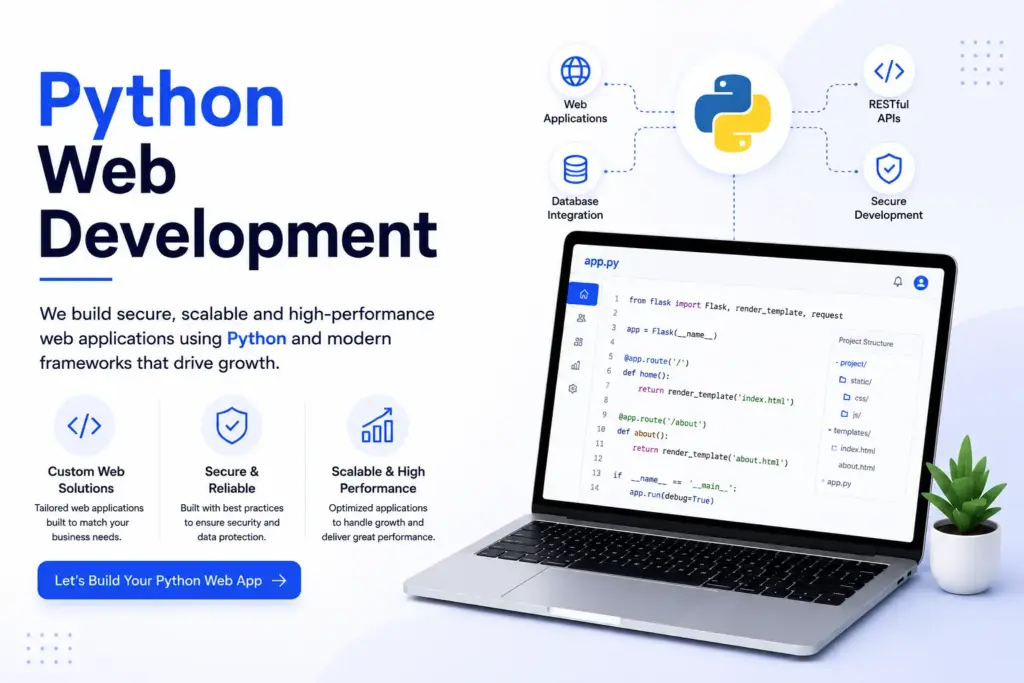
If you have asked any developers about what language should your next web project be built in, it’s quite possible that Python came up within the first few sentences. It’s not hard to see why. And slowly Python became one of the most popular, general-purpose, business-friendly languages on the planet being used anywhere between simple internal tools to large platforms managing millions of users. So for all the businesses interested in Python web development in 2026, it’s worth knowing what this language is famous for and how to find a team, who can build with it.
In this guide we discuss what Python web development really means, why so many businesses are adopting it and what to look out for when assessing potential development partners, including how Codiotic approaches this type of work.
Why Python Has Become Such a Popular Choice for Web Development
The popularity of Python isn’t a passing trend. These are all about tangible benefits which actually help speed up development, make it more reliable and prevent maintenance headaches down the line.
One of the observable traits of Python is its clean, readable syntax, which allows for faster development time and provides a smaller surface area for bugs to find their way through. It boasts a vast ecosystem of libraries and frameworks that cater to virtually any use case from web development through data science to artificial intelligence. As a result, it tends to be easier to find talented individuals or teams who can develop and maintain your application because so many developers know Python.
Python web application development gives businesses this especially solid base where modern day web applications, particularly those that will eventually expand to include more of the areas where Python already dominates (AI, data analysis, automation).
Advantages of Python for Web Development
However, in 2026, why Python remains competitive for businesses:
Fast Development Cycles
With its simple, readable syntax, developers using Python can build and iterate faster than in more verbose languages. This speed can be a real competitive advantage to the businesses which are looking to get things done quickly, mainly in cases of launching the MVP or providing business solutions according to market needs.
Great for artificial and data-driven services
If you have used Python for AI and data science, answer more than once. When your business is going to use AI features, predictive analytics and data-heavy functionality in the web application (today or tomorrow), it will be pretty easy to integrate if it is built on Python from day one.
Strong Framework Ecosystem
Frameworks in the Python ecosystem like Django and Flask have become more mature, well-documented, and powerful for developing simple websites to complex scalable web application. For example, Django is notoriously called a ” batteries included” framework which takes care of much of the heavy lifting regarding security, database management and administration right out-of-the-box.
Highly Scalable
That said, it was presumed that an application using Python would be much slower than the equivalent one implemented in compiled languages, and due to this extended knowledge of bad architectural patterns with python it is believed that python should not be used for big scale applications. Python powers massive user bases on major platforms, showing that it can scale beyond simple read more projects if built with the right infrastructure decisions in place.
Strong Community and Long-Term Support
Python has one of the biggest and most active developer communities in the world. What this means is a cycle of constant improvement, deep documentation and a continual increasing pipeline for talented developers to support and maintain your application for many years.
Versatility Across Use Cases
With strength across data science, automation, and AI beyond just web development, Python means your dev team can deliver a web app today that is inherently built to scale into more complex, smarter capabilities tomorrow.
Typical Scenarios of Python Web Application Development
As a bit of context for this, below we have outlined some areas where Python tends to shine in real-world business scenarios.
- Data-driven platforms — Python is well-known for data processing, analytics or reporting which are the core use cases for plenty of applications.
- AI applications — Because of the dominance of Python in AI and machine learning domains, it is a great technology for web apps that using intelligent functionalities like recommendations, predictions or automation.
- SaaS Products — Frameworks for Python, especially Django is a great option to create enterprise-level and subscription-based software products.
- Internal business tools — Because of the speed with which you can build simple UIs, python is well gelled with the use a lot for internal dashboard, admin tool and automation systems.
- Fintech and healthtech tools — The robust security features of Python and its mature ecosystem lend it well to the needs of highly regulated industries.
These use cases represent real patterns of how Python is being used in enterprise settings today, particularly as more organizations explore building applications that can evolve towards smarter, AI-powered capabilities.
Python vs. Other Web Development Technologies
While this is a repetitive question that organizations hit early in their planning stages, it’s good to answer it head-on.
Languages and frameworks have their own advantages. Some have tightly crafted raw performance for a pretty limited use (know your domain, which is common), and others may just have the largest codebases (measure that in enterprise regions). However, Python is always the winner based on speed of development, readability and its unparalleled power in AI & data specific functions.
For a more usual business application quite standard; i.e. without unusual need of complexities can be easily used by few languages. However, if you are going to use data analysis, automation or AI features now or in the future Python gets a real edge due to the ecosystem this is really difficult to replicate with other options.
What is The Criteria Needed for Python Web Development Services
In fact, not every development team providing Python web development services offers a similar experience or skill level. This is what you need to care about when looking at potential partners.
Deep Framework Experience
For example, if you are looking for experts on Django, Flask or FastAPI experienced developers ask specifically. Knowing Python in general does not equate to having practical experience building production web applications using these frameworks.
Strong Backend and Database Skills
Given that Python web projects often typically require a lot of additional backend related logic and use as well data, make sure to choose a team with real world experience in aspects such as database design, API development and building systems that hold up under actual load.
Using AI and Data Integration
Should you ever hope to add AI features into your app in the future, look for a partner that has actual experience integrating Python web development with Python’s data science and machine learning strengths.
Security-Conscious Development Practices
Ensure that your developer treats security as a core component of the development process right from time zero, especially if you expect your app to handle any sensitive user or business data.
Clear Communication and Process
You will be able to grasp the goings on within each phase of your project, without requiring a deep dive into the technical underpinnings. An excellent group break down their procedure in laymen language and advise you on a regular basis.
Post-Launch Support
Like all serious software products, Python applications require maintenance, updates and bug fixes. Seek out a partner that will support you long after the go-live.
Step-By-Step Process For Python Web Development.
Having an understanding of what a standard process looks like allows you to assess whether the approach your potential partner is taking actually fits together for what you are building.
- Discovery and planning. The best team must know your business goals, user types and technical decisions before choosing the framework or architecture at the start.
- Framework and architecture selection. This involves selecting a framework (Django, Flask, etc.) and designing the system architecture & data model of your application.
- Iterative development. You are building in phases, ideally with a constant feedback loop that allows you to adjust the trajectory of your project based on the current version while avoiding months elapsed waiting for a finished product.
- Testing and quality assurance. Testing through various corner cases is a good way to capture issues before hitting customers in production, especially for applications that process sensitive data or complex logic.
- Deployment and ongoing support. Post-launch, continuous monitoring, updates and maintenance of the application is crucial to ensure seamless functioning as your business and user base expands.
Why companies creating AI applications often pick Python
This is something worth calling out specifically as it is one of the biggest reasons companies go for Python in new projects.
If any sort of AI-driven application feature smart recommendations, predictive analytics, natural language processing, automation is at all likely to be introduced into your web app at some point down the line, building on Python from day one will substantially smooth the transition process. Instead of having to graft on AI functionality using an entirely different tech stack, Python would allow your web application and your AI capabilities to share the same ecosystem so that those systems can be integrated efficiently with a cleaner design and architecture while allowing for easier long-term maintenance.
Choosing a Python Web Development Company
If you are hiring a python development company, here is how to take the measure of legitimate specialists vs. generalized developers with an occasional passing familiarity with Python.
Requests for unique examples of Python projects. The traditional North American indication of a real Python web development company would be that they will demonstrate you examples of the excellent options in relation to your indusry/use case infrastructure and do not just share portfolio.
Dig into their framework expertise. Find out what frameworks they typically work with and why they would have a specific framework in mind when your project is being developed.
Check their experience with scalability. Inquire about their approaches to handling performance and scaling challenges, given that the quality of implementation plays a major role in this area.
Enquire about artificial intelligence and automation capabilities. Learn if the team truly has a track record of blending Python web development with the work of AI and data science, since you might want smart features in the future.
Codiotic: Best-Fit Python Based Web Development Solutions
We are going to be frank here as it is truly how the team handles these projects.
Codiotic is a top-rated AI and custom software development company helping businesses build innovative, scalable, and future-proof digital solutions. From AI-powered applications and enterprise software all the way to web platforms, mobile apps, SaaS products, and cloud-based systems, it combines relevant tech with actual industry know-how that helps solve pressing business challenges.
Instead of rushing to frameworks or architecture, as a Python web development company Codiotic aims at first to understand the real business need you are trying to solve and what your longer-term goals are. The approach is the same whether you are building a data-heavy Python web application development project, or trying to build your business application that would allow incorporating AI features in the future, you only need to create something secure, scalable, real and not just anything that will work once for an MVP.
The team has genuine experience on Python frameworks like Django and Flask, along with strong AI and machine learning capabilities that are second nature due to the big picture focus of Codiotic being an AI & software development company. That mix positions Python applications developed by Codiotic to include integrated, AI-driven intelligence as a business scales, setting the team apart from more narrowly focused Python web development services providers.
Questions To Ask Before Making Your Commitment
Go through this checklist of questions before signing on a Python development partner:
- Have you had experience working on Python projects that are comparable to the size of my project?
- What frameworks do you typically use, and why?
- As your application grows, how you think about performance and scalability?
- Have you integrated any AI or data-driven features inside Python applications?
- What type of post-launch support and ongoing maintenance do you provide?
- Who will I primarily work with during the project?
In contrast, clear something and very specific answers are a best sign their company actually has deep experience with Python. The newcomer usually is good at dealing with vague or too generic reactions.
Final Thoughts
In 2026, Python has stood the test of time as robust for modern web application development and is probably one of the more famous, developer-friendly languages a business can use if they want to build features or components with AI, automation, or data-driven approaches in mind now or down the line. Depending on whether you are investigating Python web application development for a new project, or switching from an existing platform, the right development partner will take time to understand your specific goals before advising on an approach.
Spend time assessing prospects, ask deep technical questions and do not hesitate to begin small or as an MVP prior to a larger build. That approach, however, will be welcomed by a team confident in its Python expertise as they know their work can stand on its merits.
Frequently Asked Questions
1. Is web development with Python a good idea in 2026?
Definitely its still also one of the best choices especially for Companies building product or services focused businesses that need to are scaling rapidly and want an agile development cycle and/or see themselves adding AI or data considerations functionality sooner plus maybe later. It has been mature enough to have a framework ecosystem and can be used on everything from small applications to large platforms.
2. The expense of Python web application advancement typically cost?
Costs Will Vary Depending on Project Complexity, Integrations Needed, and the Scale of Application Being Built Type of quote, A reliable company for Python web development will give you an exact, detailed estimate based on your unique needs instead of a generic, one-size-fits-all quote.
3. Which is better for Python web development: Django or Flask?
Django is a full-stack framework that contain all the built-in security, database management, and admin tools which is how it can handle larger and more complex applications. Flask sits at the lighter, more flexible end of the spectrum and is generally chosen when a smaller project or application with a more bespoke architecture is required.
4. How much time is required for a Python web development project?
Timelines depend on complexity, but more straightforward apps or MVPs might only take a few months to build while bigger and more complex platforms may take six months or even longer, particularly if there are substantial integrations or AI capabilities integrated into your platform.
5. What makes Codiotic a better choice for the Python web development project?
Codiotic is a one-stop-shop for web application development and in the world of AI, our deep python programming with websites ownership means that we have not just necessary skills to build usable applications, but also are well-positioned to develop intelligent features as your business expands. They will work on knowing your particular goals and needs, unlike the typical one size fits all answer.