
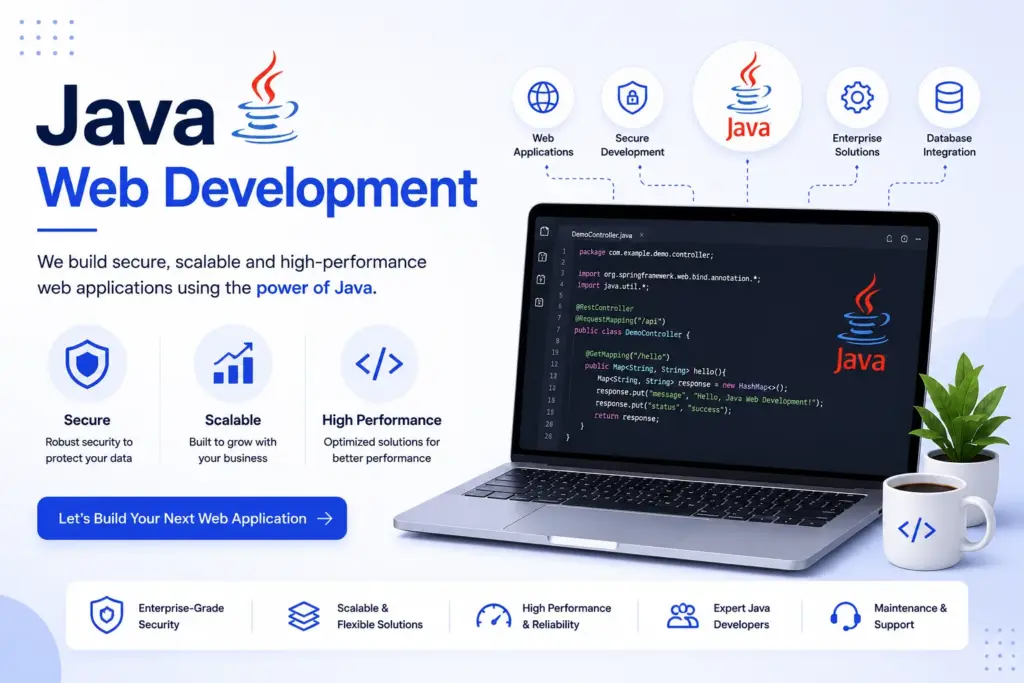
Java has been one of the most reliable and popular programming languages for web application development for decades. That’s not an accident, Java continues to power enterprise, financial, and other large-scale systems where reliability truly matters over flashier and hipper frameworks. In 2026, if your business is planning to build a Java web application, you’ll be working with a mature, secure, and highly relevant technology.
This guide explains Java web development, its benefits, and how to choose the right development partner, why so many businesses still love it, and how you can select the best partner for your project plus how a firm like Codiotic would tackle these builds.
Why Java Remains the Best Choice for Web Application Development in 2026
With so many modern programming languages available today, many businesses wonder whether Java is still the right choice.
The answer lies in Java’s proven strengths. Java is robust, secure and highly proficient in processing extremely large-scale high-traffic applications without breaking down. Whether it is a platform, your applications written in Java can run identically from one operating system to another. And it has a huge, venerable ecosystem of libraries, frameworks and tools that help to make constructing complex systems more approachable.
Java web application development is still one of the most reliable options for businesses creating applications with serious transactional volume, complex business logic, or long-term maintainability in mind think banking systems, enterprise software, and large e-commerce platforms.
A few of the key benefits of Java web development
Next, let us get down to the details of why Java has continued to prove in 2023.
Strong Security Features
Java has language-level security features out-of-the-box and so far a long history of security patches, community effort around upgrading them. That security foundation means a lot for companies processing sensitive data financial records, health information, personal data about customers.
Scalability for Growing Applications
Java applications historically scale and well, whether that means an increase in user traffic or a boost in features or sheer amounts of data. This is one of the wide reasons why several big enterprises still rely on Java for their core systems.
Platform Independence
Java follows the “write once run anywhere” philosophy, and applications can be deployed across various environments with minimal rework thereby enhancing simplicity in deployment and reducing maintenance nightmares down-the-lane.
Mature Ecosystem and Frameworks
Frameworks such as Spring Boot, Hibernate and Jakarta EE have matured significantly through the years, giving development teams powerful, well-documented tools for building everything from a simple web app to elaborate distributed enterprise systems.
Strong Community and Long-Term Support
Java isn’t going anywhere. It has one of the biggest developer communities on the planet, which means constant support, frequent updates as well as a continuous supply of experienced developers who can keep your application up and running far into future.
Excellent for Complex Business Logic
The four pillars of Java’s structure and object-oriented design makes it a great fit for complex business rule heavy applications, as well as systems with complicated workflows and integrations, where a lighter weight language might actually begin to struggle.
8 Common Use Cases for Java Web Application Development
To get believably specific, here are the real-world projects where Java shines.
Enterprise resource planning and business systems, Java is far more stable, scalable, and mature for enterprise applications that must continue running reliably over many years.
- Financial and banking platforms — Java is a solid choice for this sector because it has decades of history regarding security and transaction reliabilit
- E-commerce — High-traffic online stores are among the core industries where Java is a key player, as many users can work together through implemented architecture without loss of speed.
- Healthcare — The stringent compliance and data security requirements of this industry together with Java’s built-in security features and mature ecosystem suit the needs perfectly.
- Large scale SaaS platforms — Java can handle extremely large user base and would be an a good choice while considering subscription based platforms which will be scaling rapidly over the years.
These are not just theoretical use cases, but rather where Java has historically performed well for decades now, which is precisely why it continues to be the best choice for production-level critical long-running projects.
The Decision of Java and Several Other Web Development Technologies
You probably have this question when you are just starting out as a business, so we might as well face it head on.
On newer frameworks and languages, people often boast better getting up running time and hipper tooling. And that swiftness can be very attractive for small and uncomplicated projects. Java, however, comes to its own when it comes to projects with a larger amount of complicated business rules in the back and / or for greater scalability needs in the future and lasting stability over several years.
Java may be overkilled if you are building a simple marketing site or an MVP quickly. However, if you want to build something with real complexity, an enterprise system, a high-volume platform or any app that needs to reliably run for a decade or more, Java web development is often where intelligence and the option of having a future-proof choice.
Essential Qualities to Seek in Java Development Service
Not every development team is created equal in terms of running Java projects smoothly. This is what counts when assessing prospects.
Deep Experience with Java Frameworks
In many circumstances, we ask specifically for experiences with framework like SpringBoot, Hibernate or Jakarta EE. This is very different from general programming experience as well as in-depth, specialized knowledge of the Java ecosystem.
Strong Backend Architecture Skills
Java projects are generally serious backend systems, so when seeking out a team look for an ability to design databases, anticipate the perf and scalability of APIs, and have practical experience building systems that grow without collapsing.
Security-First Development Practices
Because Java is often used in sensitive, high-stakes applications, your development partner should consider security a foundational part of the build process and not retrofitted at the end.
Clear Communication and Process
It should not require a computer science degree to keep track of where your project is. An experienced team will always explain you the process well and continuously update you during the development.
Post-Launch Support
In the case of Java applications, primarily enterprise systems, you will always have to provide maintenance, updates and occasionally even fixing problems. Features like prolonged java postlaunch development based solution from the partner.
Steps Involved in the Java Web Development Process
By seeing what a standard process looks like, you can decide if how a potential partner works makes any sense.
- Discovery and requirements gathering. An excellent team first understand your business needs, current systems and technical requirements before writing a single line of code.
- Architecture and system design. This consists of selecting the proper Java framework, how to structure the database, and what standards will outline with different methods in general.
- Development in stages. Building usually takes place in phases, and it is most advantageous to have regular check-ins so that you can give feedback while progress is being made rather than waiting months for a finished product.
- Testing and quality assurance. The intricate nature of many Java applications makes extensive testing in diverse scenarios and edge cases necessary before release.
- Deployment and ongoing support. Post-launch, the system requires ongoing monitoring, updates, and maintenance to ensure it continues to function as your business grows.
Reasons Why Java is the Preferable Programming Language for Enterprise Businesses
And as Java’s strength in large scale enterprise systems comes even more to the fore. Enterprise systems need to integrate with many of the software that is already in place, support hundreds or thousands of concurrent users, and must meet strict security and compliance goals, all areas where Java has been able to prove itself.
Another aspect of Java is its mature ecosystem, which means that there are tons of existing tools, libraries and frameworks which address enterprise-level challenges so that the work won’t have to start from scratch. This speed through a simple framework together with the basic reliability that enterprise systems need can level up development for complex projects significantly.
How to Select the Appropriate Java Website Development Firm
Java is an impressive programming language that has many global representatives. Out of this huge number, it is hard to determine the real Java specialists from those who are only generalists and barely use Java in their daily work or do as little as possible with it.
Request few examples of a Java project. A bona fide Java web development firm will be ready to provide you with extensive examples of real-world, Java-based projects instead of simply providing a standard portfolio that happens to contain one or two isolated Java applications.
Dig into their framework expertise. Find out what frameworks they use the most, and why they’d recommend that approach for your project.
Check their approach to scalability. Java, as you may know, is usually selected solely for its scalability, so ask your prospective partner to back it up with a decent explanation on how they built their systems to handle scaling.
Request references from similar projects. Speaking to past clients about their experience, particularly on projects similar in scope to yours, can reveal more than a portfolio could ever show.
Why I Prefer Codiotic: Best Java Web Development Company
And this is where we are being transparent, because it truly has everything to do with how the team approaches these projects.
Codiotic is a top-ranked AI and custom software development company specializing in building innovative, scalable, future-ready digital experiences for businesses all across the globe. The team integrates advanced technologies with real industry expertise from the AI-based applications and enterprise software to web platforms, mobile apps, SaaS products, cloud-based systems all to solve intricate business needs.
Codiotic being a Java web development company, the first priority is to grasp the actual business problem and technicalities before any architecture or framework. Whether it be building a larger enterprise client-solution Java web application development project, or smaller but very laser-focused builds for growing businesses, the mentality is the same build something secure, scalable and genuinely aligned with long term reliability and not just so that you have something to demo.
The team comes with actual experience of working on modern Java frameworks and enterprise applications architecture coupled with extensive software lifecycle and AI experience enabling the organizations to build intelligent automation into their Java system for a future-ready business. This unique blend of deep Java know-how and breadth of technical capability is helping Codiotic stand apart from generalist Java dev houses.
Questions to Consider Before You Sign Up
Before signing on with any Java development partner, run through these questions:
- Can you show me Java projects you’ve built that are similar in complexity to mine?
- Which Java frameworks do you use most often, and why?
- How do you approach scalability and performance optimization?
- What’s your process for testing and quality assurance before launch?
- What kind of post-launch support and maintenance do you offer?
- Who will be my main point of contact throughout the project?
Answers to these are clear signs that a company does indeed have deep Java expertise. Responses that are too vague or downright generic tend to be best treated as red flags.
Final Thoughts
In 2026, Java is still one of the most stable scalable options for serious web development projects especially suited for businesses developing complex systems who require their solutions to stand the test of time. Regardless of whether you are searching for Java web application development to build a new system for an enterprise or to modernize an existing platform, the right development partner will not jump into suggesting a method without truly understanding your unique needs.
Spend time in checking your potential partner, move gradually and consider opting for a micro phase before scaling to bigger projects. That will be welcome by a team that are certain in their Java prowess because they know their work will speak for itself.
Frequently Asked Questions
1. Web Development: Java Still a Good Choice in 2026
The answer is, Yes!Java is still a popular language to go with, especially for sophisticated or large scale/enterprise-grade applications where stability, security and long term scalability are important. It’s mature and battle-tested, making it especially favorable for companies building systems intended to thrive for years.
2. What is the cost of developing Java Web Applications?
These costs vary depending on the complexity of the project, required integrations and the scale system one is planning to build. The enterprise-level projects using Java typically cost more than less-complicated applications because they need to take account of extra architecture, security and scalability factors.
3. How is Java different from other web development languages?
Java is ideal for complex business logic and large applications built to last, whereas other languages may be better suited for smaller, simpler projects that require fast initial development. The correct option depends on your project needs and goals in the long term.
4. How much time does it normally take for a Java web development project?
The timelines can differ based on the complexity of applications, small Java app may go live in a couple of months and for larger enterprise systems it could take up to six months, or possibly longer such as 1 year or more with significant integrations or custom features involved.
5. What is Codiotic for Java Web Development?
Codiotic presents an extensive experience with Java Development along with broader software and AI features, which means that the framework made is not only useful but also grows as your business enlarges. This team works to learn each technical and business need first, before providing a very general, one-size-fits-all resolution.