
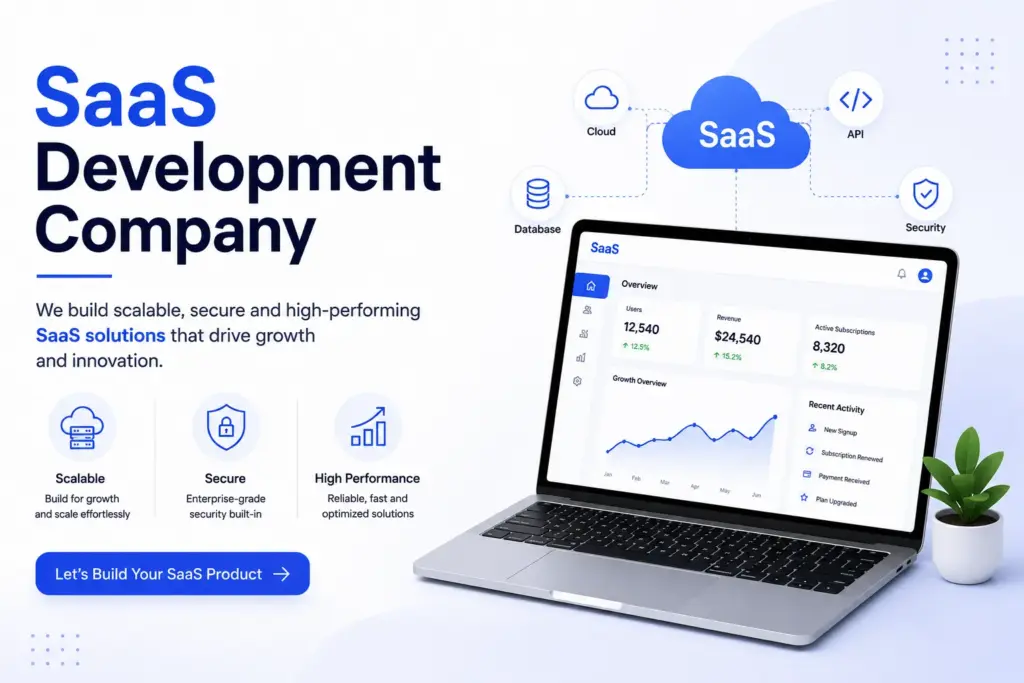
Developing a SaaS product is one of the most exciting things for any business or venture partners as well as it is probably the risky thing to do, if you chose to go with the wrong development partner! SaaS is not as simple as a website or even an app, but rather a living, breathing product that needs functionality for a multitude of users, complexity around billing and subscription tiers, continuous updating post-launch and security protocols that need to be stricter than it would be otherwise as you grow. Selecting a good SaaS development firm is not only a technical choice, it’s a business decision that will determine the future of your product for years to come.
The SaaS market of 2026 is more competitive and more mature than any before it. From day one, users demand clean/fast/reliable product and investors a scalable architecture that does not collapse on the first growth spurt. This is a guide that takes you through all the steps you need to look for before picking a partner, what are some of the things to watch out for, and how Codiotic approaches SaaS Projects unlike how any company might.
Importance of Choosing the Right SaaS Development Company
It is a living product, as opposed to a brochure website, how one-time projects go. This is a platform that has to grow as you grow, built on top of a solid architecture which can scale and with developers who are experienced in working with subscription-based systems, running multi-tenancy systems and building for the long-term.
Choose the wrong SaaS development company, and your product may work well for fifty users but crash with five thousand. You may find out months down the line that the architecture was not designed to scale, security tenant was neglected well or your subscription billing system is a tangled mess that breaks every time you add any new pricing tier. These are not theoretical problems, they happen commonly, and almost always arise from bringing on a partner lacking SaaS equation experience.
Difference of SaaS Development with Conventional Software Projects
It is a good idea to first understand what actually differentiates saas application development from building a regular website or app, before we go into how to choose a partner.
Multi-Tenancy Architecture
The majority of SaaS products need to support many customers (or tenants) from the same codebase and underlying infrastructure while isolating each customer’s data and ensuring it is protected. One of the most technically challenging aspects of SaaS Development is getting this architecture right from day one.
Subscription and Billing Logic
SaaS products have multiple pricing tiers, free trials, upgrades and downgrades as well as billing on a repeating basis rather than from a single purchase. This logic has to be thoroughly built out otherwise, customers still pull their hair out at billing errors, and you lose revenue!
Scalability from Day One
A SaaS product must scale to at least an order of magnitude larger (from ten users to ten thousand) without a complete system rewrite. It is about seriously considering cloud infrastructure, database design and performance optimization much earlier in the pipeline.
Continuous Deployment and Updates
SaaS products are never really finished. This calls for live deployment of upcoming features, covering bugs and security vulnerabilities with zero downtime for the current users.
Security and Compliance
Many SaaS platforms work with private customer data for a multitude of different businesses, meaning security and compliance needs like SOC 2, GDPR, or strict industry regulations, are typically much higher than any standard website project.
What to See in a SaaS Development Company
Now let’s get practical. Here’s what you should actually be evaluating when comparing potential partners.
Proven SaaS Portfolio
Begging for general software development experience, you should look for SaaS product development experiences in the specific. Request for products they have developed, and probe the way those items have expanded since their beginning. A company that has only made brochure websites or simple apps may not have the specialist experience needed for SaaS architecture.
Robust Backend and Cloud Infrastructure Knowledge
The backend architecture of SaaS products is their heart and soul. Enquire with your potential partners about their experience in cloud platforms, database design, API architecture and how they manage scaling when the user base increases.
Experience with Subscription Billing Systems
Surprisingly, this is a very common pain point. Ensure your dev partner has actually integrated subscription logic into their product, especially for corner cases (like failed payments, changing plans, etc.
Security-First Development Practices
SaaS platforms handle a lot of sensitive data so make sure you ask very specifically about their process for things like data encryption, access control and compliance with any regulations within your industry.
UI/UX Expertise
Because SaaS products either survive or die based on usability. Technical solution is not enough, you could build a technically sound platform even an awesome one, but if its too confusing or acts as clunky experience it will dump out of retention user. Choose a partner that makes design an integral part of the process, not something you do at the end.
Post-Launch Support and Iteration
SaaS products are never done and continue to evolve long after they launch. Find a partner with ongoing saas development services like feature updates, performance monitoring, and assistance when scaling.
Custom SaaS Development vs Boilerplate
This is enough of a fork in the road for many founders that it is worth tackling explicitly!
SaaS boilerplates and templates can lure you in with promises of faster launch. And for extremely simple, generic products, they can be ok. Yet they frequently have real restrictions, inflexible structure, generic functionality not aligned to your business model and rock-hard very difficult when it comes to personalizing core characteristics as your product advances.
Conversely, custom SaaS development is around your product vision, your users and prepared for the long haul. It typically takes longer and is more expensive upfront, but provides you with a platform that is really designed for your business not forced into an approximate shape around someone else’s framework. Custom development is almost always the better long play for any founder serious about building a scalable, differentiated product.
SaaS Development Stage – The Process of SaaS Development (Step by Step)
This familiarity with the usual process can help you assess if a potential partner’s way of going about things is reasonable.
- Discovery and planning – The best teams begin without writing a single line of code, knowing your business model, exact target users and core value proposition to be delivered. This stage should also determine your MVP, the core functionalities that you need to launch and start receiving real user feedback.
- Architecture and design – Which is not just the UI/UX design for the real-world user experience but also defining your tech stack, database structure, how you want to build out multi-tenancy, and how your data is structured Geo-database serving.
- Development and iteration – Building is iterative, ideally that means frequent check-ins and the possibility of adjusting course based on early feedback, not disappearing for months only to re-emerge with a polished product.
- Testing and quality assurance – SaaS products are complex applications, hence it is of utmost importance to test the product for various user scenarios, edge cases and multiple load conditions before launching.
- Launch and ongoing support – The work doesn’t stop after launch however, monitor the performance, user feedback and some trial runs will hardly lead to a subsequent iteration of the product based on actual data.
What Startups Should Prioritize
FIf you’re a startup building your first SaaS product, a few things matter more than others.
Start with an MVP, not a fully-featured platform. It’s tempting to want every feature from day one, but a focused MVP lets you validate your idea and get real user feedback before investing heavily in additional functionality.
Choose a partner comfortable with ambiguity. Early-stage SaaS products often evolve significantly based on user feedback. Look for a development team that can adapt as your product direction shifts, rather than one locked into a rigid, unchangeable plan.
Prioritize scalable architecture even at a small scale. You don’t need enterprise-level infrastructure on day one, but the foundational architecture should be built in a way that won’t require a complete rebuild if you do scale quickly.
What Established Businesses Should Prioritize
If you already have a business and are adding on a SaaS product, things change around a bit.
I would say that, integration with the existing systems is very critical in nature. Your new SaaS product will probably want to interface with other CRMs, databases or internal tools, so find a partner with expertise in quickly weaving this together.
The approach to compliance and security becomes heavier. Because most established businesses already have customer trust at stake, security and regulatory compliance must be considered from day one.
Look for enterprise-grade scalability. If you have an existing customer base that will use the new product then your platform should support lots of traffic and usage from day one.
Top 7 Reasons Why Codiotic is Your BEST Choice for SaaS Development
Now this is where we go fully honest because it captures precisely how the team approaches every project.
Codiotic is a top AI and custom software development company that helps businesses craft innovative, scalable, and future-ready digital solutions. The team integrates cutting-edge technologies and the real knowledge of industry experience to develop unique solutions for any business challenge, whether that is an AI application and a web platform or enterprise software, mobile apps or SaaS products and cloud-based systems.
As a SaaS development company, Codiotic measures success at understanding the true business model and user needs before making architecture or design decisions. It does not matter if you are working on an early stage SaaS development for a startup validating some new idea or it is a part of larger SaaS product development effort for an established business with domain expertise looking to add more products to its portfolio, the approach does not change, Build something that works securely and at scale and will produce real value when in production as opposed to simply creating something that can work for demo purposes!
With real experience in multi-tenancy architecture, subscription billing systems, cloud infrastructure, and the larger AI knowledge necessary to create SaaS products right for innovation down the line, whether it be intelligent automation, predictive analytics or even AI capability. And this combination of deep technical depth in SaaS with a strong AI capability, is part of what sets Codiotic apart from more narrowly focused SaaS development services providers.
Questions to Ask Before You Commit
Before signing on with any development partner, run through these questions:
- Can you show me SaaS products you’ve built, and how have they scaled since launch?
- What’s your approach to multi-tenancy architecture and data isolation?
- How do you handle subscription billing, including edge cases like failed payments or plan changes?
- What does your security and compliance process look like?
- How do you support the product after launch as user needs evolve?
- Who will be my main point of contact throughout the project?
Clear, specific answers are a good sign that a company genuinely understands SaaS development. Vague or overly generic responses usually mean it’s worth looking elsewhere.
Final Thoughts
The most significant choice you will make when developing a SaaS solution is to select the right SaaS development companion. Not just a team that can write code, finding someone who understands multi-tenancy architecture, subscription billing, scalability, and the realities of building products that need to keep working (and improving) long after launch.
Be patient with your evaluation, dig deep into the technical aspects and be willing to roll out a small in-scope MVP before fully integrating it as part of your platform. Any partner worth pursuing will appreciate that kind of an approach, because they know a good foundation will only set you up to scale over the long term.
Frequently Asked Questions
1. What is the average cost of custom SaaS development?
The costs change considerably based on the complexity, features and scale of infrastructure required. An MVP would probably cost an order of magnitude less than a fully-featured, enterprise-would-be-proud-to-use something. A good SaaS development company will provide you an estimate in a well-defined, itemized format as per your needs.
2. How long does it take to develop a SaaS product from the scratch?
Timelines are highly contextualised by the scope, but a focused MVP could take a few months, whereas a complex feature complete platform would take six months to one year plus. The fastest way of getting real user feedback is to start with a smaller MVP.
3. What is the difference between SaaS application development and building usual web-application?
SaaS application development is more complex, including things like multi-tenancy architecture, subscription billing and continuous need for scalability, a traditional web app usually serves one organization or use case without those recurrent, non-single-customer demands.
4. SaaS boilerplate or custom SaaS development?
Boilerplates can suit really simple sweet board products and quicker launch cycle, however ultimate customized SaaS development gives a more market-oriented flexibility, long-term scalability, and context that’s tailored especially to your business model rather than just another template.
5. Why you must have Codiotic for your own SaaS development and in the best interest.
Codiotic blends expertise in building scalable SaaS products with a massive software and AI Capabilities so that the products built are not just functional but also designed, architected to scale evolve in tune with your business growth. Instead of offering you a matchbox solution, the team first tries to get an understanding of your business model.