
AI Agent vs Chatbot vs Automation: How to Choose the Right Solution
An AI agent is not always the right solution for a business problem. In conversations with business leaders, one request comes up again and again: ‘We need an AI agent.’ When we ask which problem they want to solve, the answer is often something like this: ‘Our team spends two hours every morning copying order details from emails into a spreadsheet.’
That problem does not need an AI agent. It needs a simple automation that can be live within days.
The terms automation, chatbot and AI agent are often used as if they mean the same thing. They do not. Choosing the wrong one leads to unnecessary cost, delayed delivery and reduced trust in AI. At Codiotic, we help businesses match the right tool to the right problem. This guide explains the difference between an AI agent, a chatbot and automation, and gives you a practical framework for choosing correctly.
Why the AI Agent vs Chatbot vs Automation Choice Matters
AI adoption rarely fails because the technology is weak. It fails because the tool was never matched to the problem.
- An AI agent deployed for a rule-based task adds cost and unpredictability.
- A chatbot deployed for a task that requires action leaves customers with answers but no resolution.
- Rigid automation applied to work full of exceptions creates more maintenance than it saves.
Getting the fit right is the most valuable decision in any AI initiative, and it costs nothing to make.
Explore the AI solutions by Codiotic.
The 3R Framework: Rules, Responses, Reasoning
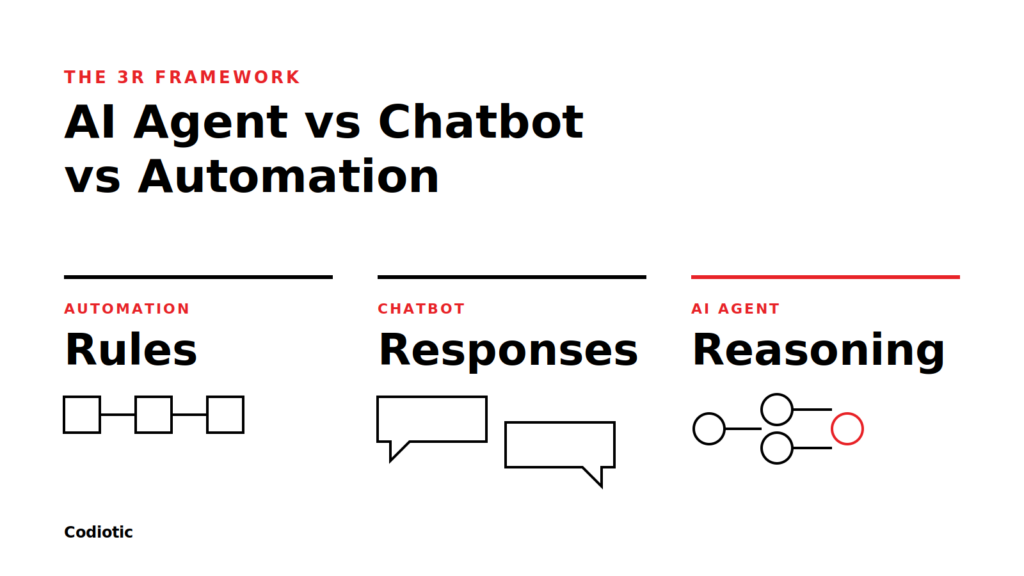
Each solution, whether automation, a chatbot or an AI agent, is defined by the kind of work it is built to do. We call this the 3R Framework.
1. Rules: Business Automation
Automation executes a fixed sequence of steps, in the same order, every time. If this happens, do that. It does not interpret or improvise, which makes it predictable, easy to test and easy to audit.
Best suited for: data transfer between systems, invoice generation, scheduled reminders and status updates.
Example: A logistics firm receives around 200 delivery confirmations by email each day. A rule-based automation reads each one and updates the tracking sheet. Staff who once spent two hours on this task now spend none. No AI is required.
Limitation: It breaks when inputs are inconsistent or the rules change frequently. If one confirmation says “delivered,” another says “left at the gate” and a third is a photograph, a fixed rule cannot handle all three.
2. Responses: Chatbot
A chatbot converses with people. It answers questions, collects basic information and directs users to the right resource. Modern chatbots built on language models understand natural questions rather than forcing users through fixed menus.
Best suited for: repetitive questions such as opening hours, return policies, order status and appointment booking.
Example: A clinic receives the same twenty questions daily, such as doctor availability and accepted insurance. A chatbot answers them at any hour, allowing the front desk to focus on patients on site.
Limitation: It informs but does not act. When a customer needs something done rather than explained, a chatbot only moves the problem to another team.
3. Reasoning: AI Agent
An AI agent works toward a goal rather than following a script. It decides on the steps, uses tools such as email, databases and calendars, checks its own progress and adjusts when conditions change. Of the three options, an AI agent is the only one that can handle situations nobody planned for in advance.
Best suited for: multi-step tasks where the path differs each time and a person would normally apply judgment.
Example: An online store receives the message, “My order arrived damaged and I need a replacement before Friday.” The AI agent reads the message, verifies the order and delivery record, checks stock, creates a replacement shipment and replies to the customer. If the item is unavailable, it proposes an alternative or escalates to a person with a full summary.
Limitation: An AI agent is unnecessary for simple tasks, and risky where errors are costly and no one reviews the output. Because it makes decisions, it needs monitoring, clear boundaries and defined escalation paths.
How to Choose: Three Simple Questions
- Are the steps identical every time? Choose automation.
- Is the goal to provide an answer or information? Choose a chatbot.
- Does the task require decisions across several steps and tools? Consider an AI agent.
Also consider what an error would cost. The higher the cost, the more human review the solution needs, whichever type you choose.
How Automation, Chatbots and AI Agents Work Together
Most organisations do not need to choose just one of automation, a chatbot or an AI agent. Consider an e-commerce return request:
- A chatbot greets the customer and understands the issue.
- An AI agent checks the order history and stock, decides on a refund or replacement and prepares the action.
- Automation then handles the routine steps: the shipping label, the inventory update and the confirmation email.
- A person reviews anything unusual, such as a high-value order.
Each layer is simple on its own. Together, they resolve a request that would otherwise involve several people and several hours.
Three Common Mistakes to Avoid
Starting with the most advanced option
If a rule-based automation solves 90% of the problem, begin there. It is faster, cheaper and easier to trust. Intelligence can be added later, exactly where it is needed.
Treating an AI agent as a replacement for people
An AI agent can make mistakes. Where money, customer data or legal exposure is involved, keep a person in the loop to review outcomes.
Skipping problem definition
“We need AI” is not a problem statement. “Our team spends ten hours a week on invoice entry” is. Define and measure the problem first, and the right tool usually becomes clear.
How to Get Started with Codiotic
- List the repetitive tasks your team handles every week and measure the hours each one takes.
- Classify each task as rules, responses or reasoning.
- Begin with one high-volume, low-risk task, prove the value, and expand from there.
If you want a second opinion on whether a task needs an AI agent or only an automation, the Codiotic team can review your workflow and recommend the simplest solution that works.
To discuss your workflow, talk to the Codiotic team.
Key Takeaway
The best AI solution is not the most advanced one. It is the one that fits the problem.
- Fixed steps: automation
- Questions and answers: chatbot
- Judgment across multiple steps: AI agent
Frequently Asked Questions
What is the difference between an AI agent and a chatbot?
A chatbot answers questions and guides users, but it does not take action on its own. An AI agent works toward a goal, uses tools such as email, databases and calendars, and completes multi-step tasks, such as creating a replacement shipment and replying to the customer.
When should I use automation instead of an AI agent?
Use automation when the steps are identical every time, such as copying order details into a spreadsheet or sending scheduled reminders. It is faster to build, cheaper to run and easier to audit than an AI agent.
Can a chatbot, an AI agent and automation work together?
Yes. In many businesses the best result comes from combining all three. A chatbot handles the conversation, an AI agent makes the decisions, and automation completes the routine steps, with a person reviewing unusual cases.
Are AI agents safe to use in a business?
An AI agent can make mistakes, so it needs monitoring, clear boundaries and defined escalation paths. Where money, customer data or legal exposure is involved, keep a person in the loop to review outcomes.
How do I know which solution my business needs?
Start by defining the problem and measuring the hours it costs. Then classify the task as rules, responses or reasoning. Codiotic can help you apply this framework and begin with one high-volume, low-risk task.
Not sure which solution fits your workflow?
The Codiotic team can review your workflow and recommend the simplest solution that works.
Talk to the Codiotic team