
Why AI Projects Stall: 5 Causes That Have Nothing to Do With the Model
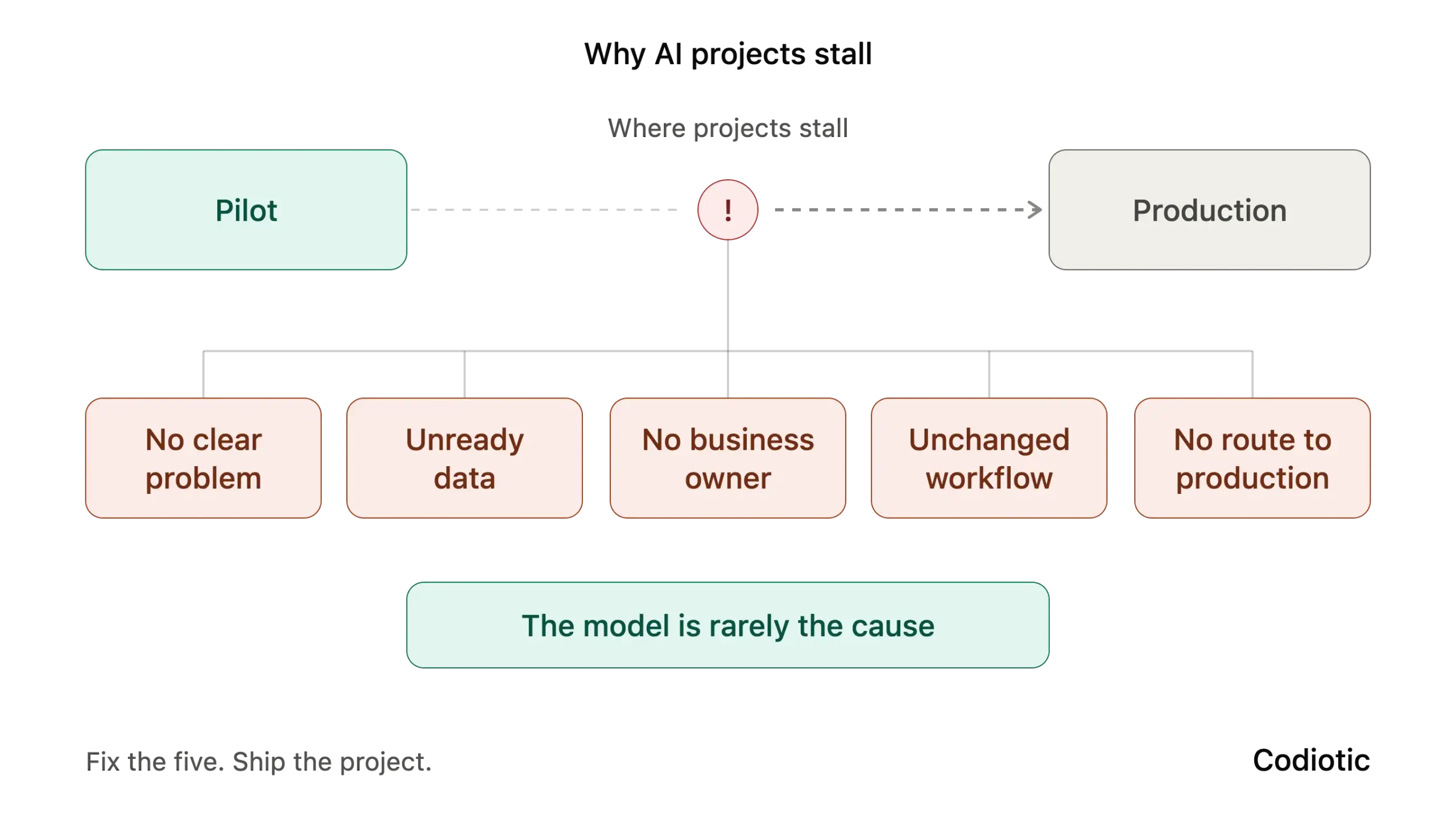
When AI projects stall, the model is rarely the cause. The real problems sit around the technology: an unclear goal, data that is not ready, nobody accountable, a workflow that never changed and no path to production.
At Codiotic, we build AI-powered software and automation for businesses, and we see the same five patterns again and again. This guide explains each cause and gives a practical fix for it. Use it as a checklist for your next AI project review.
Why AI Projects Fail Before the Model Ever Matters
Building an AI model is only one part of the journey. Real value comes when AI solves a defined business problem, fits into existing operations, and moves from experimentation to everyday use. When any of those pieces is missing, AI projects lose momentum, however good the model is.
Cause 1: No Clear, Measurable Problem
"Use AI in support" is a direction, not a goal. Ambition without a measurable target leaves AI projects with nothing to be judged against, so the work drifts and the results are hard to defend.
The fix: Define the outcome in one sentence with a number. For example: reduce first-response time from 6 hours to 1 hour. A statement like this tells the team what to build, which data it needs and how to prove it worked. If you are not sure which workflow to start with, our AI workflow automation team can help you pick one.
Cause 2: Data That Is Not Ready
AI is only as reliable as the records behind it. Incomplete or outdated data produces confident but incorrect answers, and confident mistakes are harder to catch than obvious ones.
The fix: Prepare the data for one workflow first, rather than trying to fix everything at once. Check that records are complete, remove duplicates and agree on one source of truth. Many successful AI projects begin with a small, focused data cleanup.
Cause 3: No Business Owner
Sometimes the technology team builds the solution and no one is accountable for the results. Without an owner, nobody decides whether the project should continue, change or stop.
The fix: Assign one business leader with a clear target and a fixed review date. The owner defines what success means and checks it on schedule. Projects without an owner eventually drift, and stalled AI projects often trace back to this gap.
Cause 4: A Workflow That Never Changed
A new tool on an old process rarely sticks. When AI adds steps instead of removing them, teams return to their old habits, and the tool goes unused.
The fix: Redesign the process with the people who do the work, then train them. Ask three questions before launch:
- Which manual steps will disappear?
- Who reviews the AI output, and when?
- What happens when the AI cannot handle a case?
Cause 5: No Route From Pilot to Production
A demo is not a deployment. Real-world use brings requirements that a pilot can hide:
- Security reviews
- System integrations
- Running costs
- Unusual cases
The fix: Plan for these from day one, not after the pilot. Many AI projects work well in a demo and then stall because nobody planned the integrations or the budget for running them. Good custom software engineering is what turns a promising pilot into a system people use every day.
AI Project Review Checklist
Save this list for your next AI project review. A healthy project can answer yes to every item:
- Is the problem stated in one sentence with a number?
- Is the data ready for the first workflow?
- Does one business leader own the result?
- Has the workflow been redesigned and the team trained?
- Is there a production plan covering security, integrations, costs and unusual cases?
How Codiotic Helps AI Projects Reach Production
At Codiotic, we build AI-powered software and automation to help businesses solve real operational problems. We start with the outcome, prepare the data, design the workflow with your team and plan for production from the first sprint.
If you are weighing where AI fits in your tools, read our guide on AI agents for small business. Or talk to Codiotic about a project that has stalled.
Conclusion: The Model Is Rarely the Problem
Successful AI adoption requires more than a working model. It requires a clearly defined problem, reliable data, business ownership, redesigned workflows and a production-ready plan. Fix those five things, and AI projects move from experiment to everyday use.
Which of these five challenges have you seen most often?
FAQ
Why do AI projects stall?
Most AI projects stall because of problems around the technology, not the model itself. The common causes are no measurable problem, data that is not ready, no business owner, a workflow that never changed and no route from pilot to production.
How do you measure success for AI projects?
Define the outcome in one sentence with a number before the work begins. For example, "reduce first-response time from 6 hours to 1 hour." A clear target lets you compare results with a baseline and decide whether to continue.
How does data readiness affect AI projects?
AI is only as reliable as the records behind it. Incomplete or outdated data produces confident but incorrect answers. Prepare the data for one workflow first instead of trying to fix everything at once.
Who should own an AI project in a business?
One business leader, not only the technology team. The owner holds a clear target and a fixed review date, and decides whether the project continues, changes or stops.
How do you move an AI pilot to production?
Plan for production from day one. Real use brings security reviews, system integrations, running costs and unusual cases. Addressing these early prevents a successful demo from stalling after the pilot.
Has your AI project stalled?
The Codiotic team can review where it is stuck and plan the route to production.
Talk to Codiotic