
AI Adoption Gap: Everyone Is Piloting AI, Few Are Running It
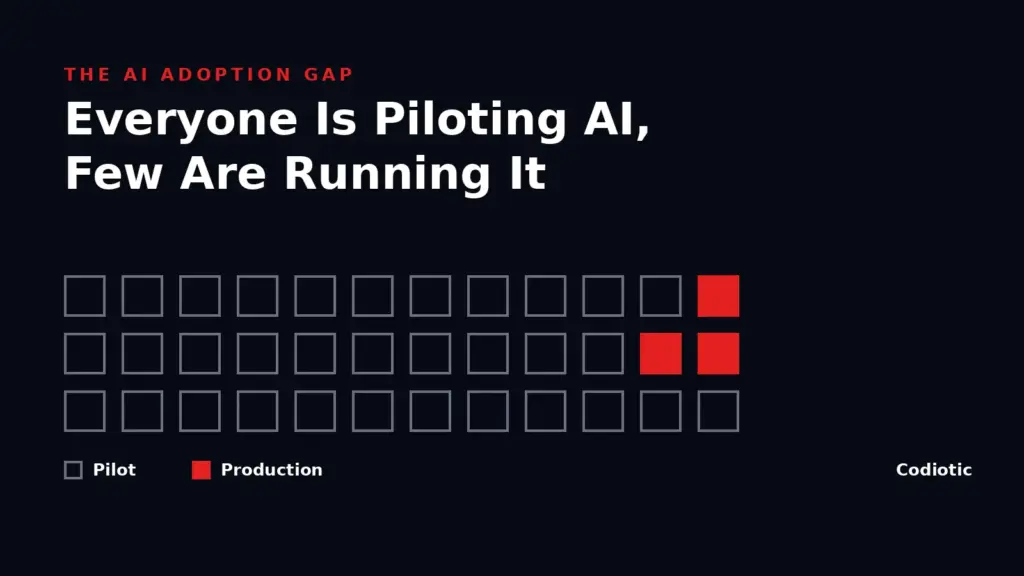
Two numbers from a 2025 global survey of nearly 2,000 business respondents tell the story of AI adoption today:
- 88% of organisations now use AI in at least one part of the business.
- Only about 39% can point to any measurable effect on enterprise-level earnings.
The gap between those figures is where most AI budgets are quietly stuck. At Codiotic, we help businesses turn technology ideas into practical, scalable software, and we see this gap often. This guide explains where the AI adoption gap really sits and gives you a five-step plan to close it.
Interest Is Not the Problem
Few leaders need convincing that AI matters. Boards ask about it, and teams are already using it. The same survey found that nearly two-thirds of respondents say their organisations have not yet begun scaling AI across the enterprise.
That matters because a pilot costs money and attention but returns little until it runs inside real operations. A company can be "doing AI" for two years and still have nothing in production that touches revenue, cost or customer experience. Successful AI adoption is measured in production, not in pilots.
Why AI Pilots Stall Before Production
A pilot is built to prove something is possible. Production has to prove it is reliable.
- A pilot usually has: a curated slice of data, a motivated team and a protected environment.
- Production has: messy inputs, edge cases, uptime expectations, auditors and users who never volunteered.
A pilot can succeed in the first environment and fail in the second without anything being wrong with the model.
The research points in the same direction. A widely cited 2025 university-led study concluded that 95% of AI pilot projects failed to deliver discernible financial savings or profit uplift. It also found that the biggest problem was not model capability but how companies used the technology.
The methodology has been questioned. One business school professor said the survey data behind the figure is unclear, with little transparency on sample size. Treat 95% as a directional signal, not a precise rate. Even sceptics agree on the underlying point: whether the true figure is 95% or lower, enterprises are struggling to move AI past proof of concept.
An earlier forecast from industry analysts is more specific about causes. It predicted that at least 30% of generative AI projects would be abandoned after proof of concept by the end of 2025. The reasons given were poor data quality, inadequate risk controls, escalating costs and unclear business value. For a closer look at the same pattern, read our guide on why AI projects stall.
The Barriers Behind the AI Adoption Gap
The same blockers keep appearing.
Data readiness. This is the most common wall. Analysts predict that through 2026, organisations will abandon 60% of AI projects that are not supported by AI-ready data. A related survey of data leaders found that 63% of organisations either don't have or aren't sure they have the right data management practices for AI. A demo can run on a cleaned spreadsheet. Production needs governed, current, accessible data.
Infrastructure and integration. A model that works in a standalone tool must still connect to your CRM, ERP, ticketing system and permissions model. The lead author of the 2025 study put it plainly: enterprise AI requires careful integration into existing systems, and without that, pilots rarely scale.
Cost. Pilot costs are small, and production costs are not. Analyst estimates put generative AI deployment costs anywhere from $5 million to $20 million, depending on the approach. Usage-based pricing, monitoring and support all grow after launch, so the business case has to cover the running costs.
Security and governance. Questions like "Are we allowed to use this data?" and "Who is accountable when the output is wrong?" often surface after the build. At that point, they can stop a project that was otherwise working.
Skills. Production AI needs more than prompt skills. It needs data engineering, integration, evaluation and operations. Many teams have strong demo builders, and few people have run these systems.
Organisational resistance. People resist tools that change their work without being asked. This is an observation from implementation work, not a measured statistic: adoption tends to stall when the team using the system has no say in its design.
Unclear ROI. If no one defined what "working" means before the pilot started, no result can justify scaling it. Many projects end in a debate about whether the pilot was successful.
What the AI Adoption Gap Looks Like in Practice
Take a composite scenario, not a specific company. A mid-sized services firm builds an AI assistant to draft replies to customer emails. In testing, it performs well on two hundred hand-picked tickets.
Then the rollout begins:
- Customer records sit in three systems, so the assistant cannot see order history.
- The legal team asks how customer data is handled.
- Support agents spend more time correcting drafts than writing from scratch, because nobody redesigned the review process.
- Cost per ticket is never measured, so no one can show a saving.
The model was fine. The workflow, data access, governance and measurement around it were not ready.
This points to a second pattern. The 2025 study found that over half of generative AI budgets went to sales and marketing, even though back-office automation yielded the highest return. Companies often fund what is easy to demo rather than what is easy to measure.
A Practical Framework: From AI Pilot to Production
These five steps reflect what the research suggests and what holds up in practice.
- Start with a workflow, not a tool. Pick one process with a clear owner, a measurable cost and enough volume to matter. "Use AI in support" is not a use case. "Cut first-response time on billing queries" is.
- Define production before you pilot. Before writing code, agree on the baseline, the success metric, the named business owner and the point at which you stop. A pilot without exit criteria becomes permanent.
- Fix the data path first. Check where the data lives, who owns it, how current it is and whether you can legally use it. Fixing this later costs far more than checking it first.
- Build integration and guardrails from week one. Connect the pilot to real systems early, even if narrowly. Add logging, evaluation, access controls and human review at the start rather than as a late "hardening" phase. Our custom software teams build this way by default.
- Redesign the work, then train the people. The global survey found that top-performing organisations are nearly three times as likely as others to have fundamentally redesigned individual workflows. Adding AI to an unchanged process rarely produces a result. If you want help mapping a workflow, see our AI workflow automation services.
One more lever is worth considering. The 2025 study's data suggested that buying from a specialised vendor, or building in partnership with one, succeeds roughly 67% of the time. Internal builds did noticeably worse. Whether you build or partner, honestly assess whether your team has done this before.
The Takeaway: Treat AI Adoption as an Operational Capability
The adoption gap is not a technology gap, and it is not a motivation gap. It is a readiness gap in five areas:
- Data
- Infrastructure
- Workflows
- Skills
- Ownership
Businesses that close it stop treating AI as a purchase and start treating it as an operational capability. That means funding the unglamorous work (data, integration, governance and change management) with the same seriousness as the model itself.
The question for leaders is no longer "Are we using AI?" It is "What would have to be true for this to run reliably on a normal Tuesday?"
If you are still deciding where AI fits in the tools you already own, read our guide to AI agents for small business.
How Codiotic Helps You Move From Pilot to Production
Moving from AI experimentation to production requires more than the right technology. It requires the right strategy, infrastructure and execution. At Codiotic, we help businesses turn technology ideas into practical, scalable software solutions.
Have an AI project in mind? Talk to Codiotic and let's discuss how to turn it into something that works in the real world. You can also explore more at codiotic.com.
What has been the biggest obstacle in moving an AI initiative from pilot to production in your organisation: data, integration, skills or something else?
FAQ
What is the AI adoption gap?
The AI adoption gap is the distance between using AI and getting measurable business results from it. In a 2025 global survey, 88% of organisations used AI in at least one function, but only about 39% reported any effect on enterprise-level earnings.
Why do AI pilots fail to reach production?
A pilot proves something is possible, while production must prove it is reliable. Pilots run on curated data in protected settings. Production brings messy inputs, integrations, security reviews, running costs and users who never volunteered. The model is rarely the cause.
What are the biggest barriers to AI adoption?
The most common barriers are data readiness, integration with existing systems, running costs, security and governance, missing skills, organisational resistance and unclear ROI. Data readiness is usually the first wall teams hit.
How do you prove ROI on an AI project?
Define the baseline, the success metric, a named business owner and a stopping point before the pilot begins. Without those, no result can justify scaling, and the project ends in a debate about whether the pilot worked.
Should a company build AI in-house or work with a partner?
The 2025 study's data suggested that buying from a specialised vendor, or building in partnership with one, succeeded roughly 67% of the time, and internal builds did noticeably worse. Whichever route you take, honestly assess whether your team has run production AI before.