 Skip to content

CASE STUDY / ERP DEVELOPMENT
Septel: A Teleshopping ERP That Follows Every Order From TV Ad to Doorstep
Codiotic built Septel, a ten-module teleshopping ERP for a TV teleshopping company. It follows every order from the advert that produced it to dispatch and accounts, in eight connected steps.
Talk to Our Team →Built by Codiotic
Septel
About the project
A ten-module teleshopping ERP that connects media, call centre, audit, inventory, dispatch, procurement, HR and accounts.
Built with
Web-based ERP with ten modules
Call-centre dialer integration
GST portal integration
QR code, barcode and shipping label generation
The challenge in running a TV teleshopping business
A TV teleshopping business looks simple from the sofa. An advert airs, a viewer calls, an agent takes the order and a parcel arrives a few days later.
Behind that sequence sits a chain of teams and systems: media buyers, call centres, quality auditors, warehouse staff, couriers, procurement, HR and accounts. When each team works in its own tool or spreadsheet, the business loses sight of its own orders.
Management needed to answer five questions every day:
1. Did the advert air in the booked slot, and how many calls did it bring?
2. Which agent handled each call, and was it up to quality standards?
3. Is there enough finished stock for today’s orders, and what needs buying?
4. Which orders are packed, handed to a courier and shipped?
5. What has each agent earned, based on the orders they closed?
Each question touched a different department. Answering any of them meant collecting information from several places, which is slow and easy to get wrong. A teleshopping ERP had to answer all five from one system.
Our solution: a teleshopping ERP built around the order
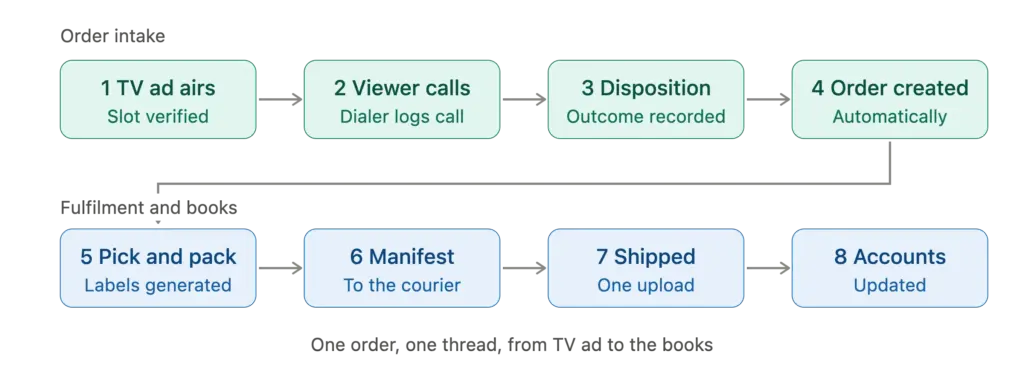
The central design decision was to build around the life of a single order, not around departments. Codiotic designed the teleshopping ERP to follow each order from the TV advert to the doorstep, and then back into the books.
Each step feeds the next. Information created at one point is available at every later point without being typed again.
This is how we approach every project at Codiotic. We start with the questions the business cannot answer, then build practical software around them. Explore our ERP and custom software development services to see more.
Inside the teleshopping ERP workflow: eight steps
01
The TV ad airs.
The media module verifies the slot.
02
The viewer calls the line.
The dialer logs the call.
03
The agent sets the disposition.
The outcome of the call is recorded.
04
The order is created automatically.
Commission and audit records are updated.
05
Pick, pack and label.
QR codes, barcodes and shipping labels are generated.
06
The manifest is handed to the courier.
07
Orders are marked as shipped.
One upload updates every order on the manifest.
08
Accounts are updated.
Low stock triggers procurement.
Ten modules in six areas
Septel is a web-based teleshopping ERP with ten modules. It integrates with the company’s call-centre dialer and with the GST portal. It does not replace the systems the company already used. It connects to them.
01
Media and advertising
Verifies that each advert aired on the booked channel and slot. Matches calls on a phone line to the ad slot that drove them.
02
Call centre and orders
Handles inbound, outbound, upsell and customer-farming campaigns. The dialer brings in calls, recordings and agent activity.
03
Call audit and quality
Auditors play back recordings inside the ERP and score agents on communication quality.
04
Inventory and warehouse
Covers inward stock, raw-to-finished production and multi-level kitting, with QR codes, barcodes and shipping labels.
05
Dispatch and procurement
Marks every order on a manifest as shipped in one step. Compares vendor quotations side by side before a purchase.
06
HR, dealers and accounts
Covers recruitment, interviews, leave and payroll. Calculates commissions from the orders each agent closed.
Technology used in the teleshopping ERP
● Web-based ERP platform with ten modules
● Integration with the company’s call-centre dialer
● Integration with the GST portal
● QR code, barcode and shipping label generation
● Recording playback and agent scoring inside the ERP
Project outcomes
Full order traceability
Management can trace any order from the advert that generated it to dispatch.
Less repetitive data entry
Automatic order creation, bulk shipping updates and commission calculation remove repeated typing.
Clear view of ad spend
Slot-wise call data shows which ads and channels are worth the spend.
Measurable coaching
Structured call audits make coaching specific and measurable.
Fair, visible commissions
Commissions are tied directly to recorded orders.
Together, these results show how a teleshopping ERP gives every team the same facts about the same order.
Browse more case studies, including our Buy Box repricing automation case study, CEO Cabs case study and LiveCrease case study. See how we work with retail and e-commerce businesses, or talk to our team about your project.
Six lessons from building a teleshopping ERP
1. Start with the questions management cannot answer.
The five daily questions became the design brief. Software built around real questions tends to be used. Software built around a feature list tends not to be.
2. Design around the order, not the org chart.
When the order is the thread through the system, departments stop being islands. Each team sees what happened before it and what comes after.
3. Connect the cost to the result.
Matching calls to the advert slot that drove them turns advertising from a cost into something that can be judged. Without that link, “is this channel worth the spend?” has no honest answer.
4. Record once, use everywhere.
Automatic order creation and one-step shipping updates work because data is captured when it is created. Re-typing the same data into a second system is where errors and delays begin.
5. Make quality measurable.
Playing back recordings in the same system, and scoring agents on a structure, turns coaching from opinion into evidence.
6. Tie pay to recorded facts.
When commission comes from the orders an agent closed, disputes fall away. The record is shared and visible to everyone.
One more point matters. Good teleshopping ERP work respects what already works. Septel integrates with the dialer and the GST portal instead of replacing them.
How to apply this in your own business
You do not need a ten-module teleshopping ERP to use these ideas. Four steps are enough to start.
1. Map your order chain. Write down every step from first customer touch to final accounts entry. Note who handles each step.
2. List the questions you cannot answer quickly. These show where information is lost between teams.
3. Find where data is typed more than once. Each repeat is a delay and a chance of error.
4. Link cost to result. For every channel you pay for, decide how you will know what it produced.
The gaps you find show where to begin. It might be a shared sheet, an integration between two tools or a larger system.
Who needs a teleshopping ERP?
This approach suits businesses that:
● Sell through TV, phone or other call-driven channels
● Run call centres, warehouses and dispatch in separate tools
● Need to link advert spend to calls and orders
● Pay agents commission based on closed orders
● Already use a dialer or GST system and want to connect it, not replace it
A long order chain does not need more spreadsheets. It needs one thread that follows the order from first touch to the books.
Frequently Asked Questions
What is Septel?
Septel is a ten-module teleshopping ERP built by Codiotic for a TV teleshopping company. It follows each order from the TV advert to dispatch and accounts.
What modules does Septel include?
Ten modules in six areas: media and advertising, call centre and orders, call audit and quality, inventory and warehouse, dispatch and procurement, and HR, dealers and accounts.
Does Septel replace the existing dialer or GST portal?
No. Septel integrates with the company’s call-centre dialer and the GST portal. It connects to what already works.
How does Septel show if an advert is worth the spend?
It verifies that each advert aired in the booked slot. It then matches calls on the phone line to the slot that drove them. Slot-wise call data shows which ads and channels pay off.
Who built Septel?
Codiotic built Septel. Codiotic is a technology company that builds web and mobile applications, AI and automation solutions.
C
Have a Similar Project?
Let's Talk.
Have a product idea in mind? Discuss how Codiotic can turn it into something that works in the real world.
