 Skip to content

CASE STUDY / SOFTWARE DEVELOPMENT
TrueRoots Supply: A Vegetable Supply Platform From Mandi to Institution by Morning
Codiotic built TrueRoots Supply, a next-day vegetable supply platform for a B2B fresh-vegetable supplier. It connects order intake, mandi buying, delivery and billing in one loop, with no manual consolidation before the morning market run.
Talk to Our TeamBuilt by Codiotic
TrueRoots Supply
About the project
A next-day vegetable supply platform that takes institutional orders, builds the mandi buying list, tracks delivery and generates bills.
Built with
Customer app
Team and delivery app
Web admin panel
Role-based access
The challenge in supplying fresh vegetables to institutions
Supplying fresh vegetables to institutions sounds simple: order today, receive tomorrow morning. Behind that promise is a tight daily cycle.
Orders must be collected before a cut-off and combined into one buying list. Buyers purchase at the wholesale market (mandi) early in the morning. Then the produce is sorted for each customer, delivered and billed. Every step depends on the one before it.
Before the platform, the supplier’s daily operations involved:
• Receiving orders through phone calls, WhatsApp and notebooks.
• Manually combining multiple institutional orders into one buying list.
• Preparing procurement requirements late at night.
• Managing quantities, sorting, deliveries and billing across different processes.
The biggest problem was not the number of orders. It was how information moved between people. One manual tally decided what buyers would purchase at the mandi the next morning. A small mistake there could affect the entire day.
A vegetable supply platform had to fix that first link in the chain.
Why daily supply cycles are different
A daily supply cycle leaves very little room for correction. The buying window is short and early. Fresh produce cannot wait for mistakes to be discovered.
If the buying list is wrong, every later step inherits the error: sorting, delivery and billing. In businesses like this, the quality of information at the start of the cycle decides the quality of everything after it.
Our solution: a vegetable supply platform built as one connected loop
Codiotic designed TrueRoots Supply as one connected loop. The principle was simple: information entered at one stage should flow into the next without repeated manual entry.
The vegetable supply platform replaces phone calls, WhatsApp messages and notebooks with three connected apps. Customers place orders. The system builds the buying list. Buyers and riders record what actually happened. Bills follow from those records.
This is how we approach every project at Codiotic. We start with where information gets lost, then build practical software around it through our custom software development services. Explore how we work in supply chain and agritech and other industries.
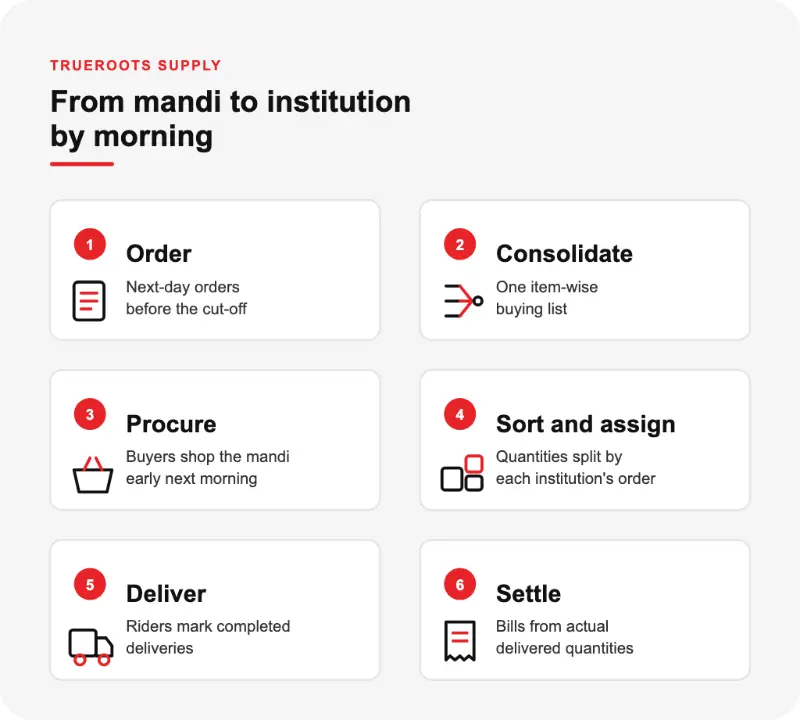
Inside the vegetable supply platform workflow: six steps
01
Order
Institutions place orders for the next day before the cut-off.
02
Consolidate
The system automatically generates one item-wise buying list for the mandi.
03
Procure
Buyers purchase the required vegetables early the following morning.
04
Sort and assign
Purchased quantities are divided according to each institution’s order.
05
Deliver
Delivery riders mark completed deliveries.
06
Settle
Actual delivered quantities are used to generate bills.
Three components, one system
The vegetable supply platform has three main components.
01
Customer app
Institutions place next-day orders before a defined daily cut-off. After the deadline, order edits are locked. The catalogue uses familiar purchasing units such as kilograms, dozens and bunches.
02
Team and delivery app
The team works through role-based access. After the order cut-off, the system generates the wholesale buying list automatically. Buyers record actual purchased quantities and rates. Delivery riders update delivery status.
03
Web admin panel
The admin panel manages institutions, credit terms and institution-specific rates. It also shows total daily demand for each vegetable.
Technology used in the vegetable supply platform
● Customer app for next-day ordering with a daily cut-off.
● Team and delivery app with role-based access.
● Automatic item-wise buying list generation.
● Web admin panel for institutions, credit terms and rates.
● Billing based on actual delivered quantities.
Project outcomes
One connected system
Order intake, procurement, delivery and accounting now run in one system.
No manual consolidation before the morning run
The buying list is generated automatically after the cut-off. No one tallies orders late at night.
Bills that match what happened
Buyers record actual quantities and rates. Delivered quantities determine the final bill.
A clear daily picture for management
Total demand, institution-specific rates and credit terms are visible in one place.
Together, these results show how a vegetable supply platform turns scattered orders into reliable daily operations.
Six lessons from building a vegetable supply platform
01
Treat the cut-off as a product feature.
A daily cut-off with locked edits might seem restrictive. But it makes the buying list reliable. Once the deadline passes, demand is fixed and the next steps can move forward.
02
Let software handle consolidation.
Combining many orders into one buying list is repetitive work. It is also one of the easiest places for manual errors. Automating it removes effort and risk.
03
Speak the customer’s language.
A catalogue built on kilograms, dozens and bunches reflects how institutions actually buy vegetables. Good software adapts to real-world workflows.
04
Record what actually happened.
Buyers record actual quantities and rates. Delivered quantities determine the final bill. When billing reflects real transactions, not just planned orders, there is less room for confusion.
05
Give every role its own interface.
Customers, buyers, riders and managers have different jobs. Role-based access keeps each person focused on their own task.
06
Give management a clear daily picture.
When management sees total demand, institution-specific rates and credit terms in one place, scattered orders become useful operational information.
Good vegetable supply platform design starts at the beginning of the cycle, because early information quality shapes every later step.
How to apply this in your own business
You do not need a full vegetable supply platform to use these ideas. If your business runs on a daily or weekly cycle, start with four steps.
1. Map the cycle. Document every step from customer order to final invoice.
2. Find manual consolidation. Identify where someone copies information from several sources into one list.
3. Compare planned with actual. Track where quantities, prices or delivery details change.
4. Set a clear cut-off. Decide when orders become final, then structure the rest of the workflow around it.
For more examples, read our Septel teleshopping ERP case study, Buy Box repricing automation case study and CEO Cabs case study, or browse more case studies.
Who needs a vegetable supply platform?
This approach suits businesses that:
• Supply fresh produce or other goods to institutions on a daily or weekly cycle.
• Collect orders through calls, WhatsApp or notebooks.
• Combine many customer orders into one purchase list.
• Need billing based on delivered quantities.
• Want separate, focused views for customers, buyers, riders and managers.
Sometimes the biggest opportunity for automation is not a complicated process. It is the simple notebook or WhatsApp thread that someone still manages by hand every day.
Frequently Asked Questions
What is TrueRoots Supply?
TrueRoots Supply is a next-day vegetable supply platform built by Codiotic for a B2B fresh-vegetable supplier. It covers order intake, mandi buying, delivery and billing.
What apps are included in the platform?
Three components: a customer app for ordering, a team and delivery app with role-based access, and a web admin panel.
How does the system create the mandi buying list?
After the daily cut-off, the system combines all institutional orders into one item-wise buying list automatically. Buyers then record actual quantities and rates.
Why does the platform use an order cut-off?
A cut-off with locked edits fixes demand at a set time. That makes the buying list reliable, so every later step can move forward without surprises.
Who built TrueRoots Supply?
Codiotic built it. Codiotic is a technology company that builds web and mobile applications, AI solutions and business automation systems.
C
Have a Similar Project?
Let’s Talk.
Have a product idea in mind? Discuss how Codiotic can turn it into something that works in the real world.
