 Skip to content

The Real Cost of AI Agents in 2026: What Token Bills Hide
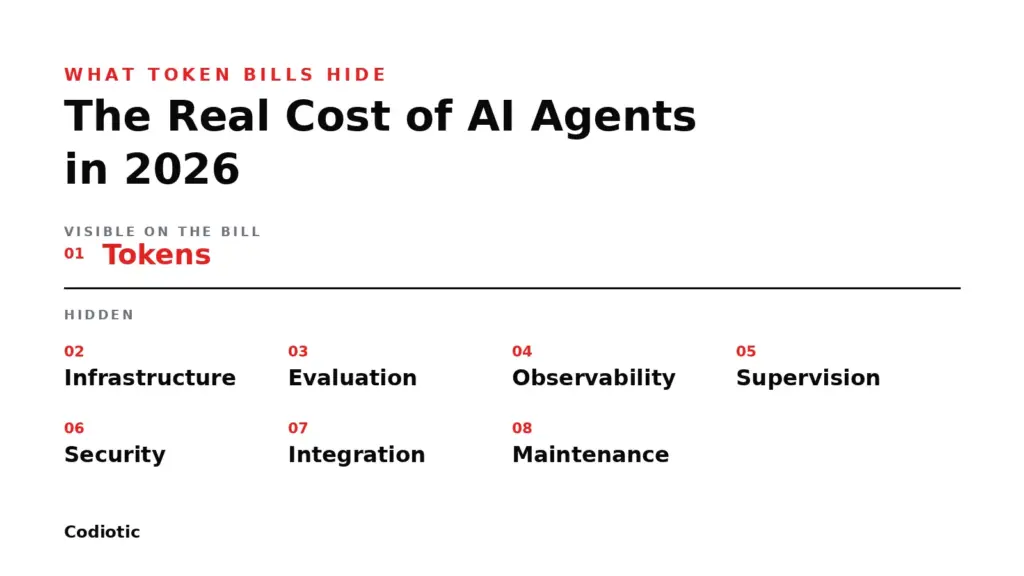
Tokens are getting cheaper. AI agent costs are not.
That sounds like a contradiction, but it is the pattern many teams are discovering as agents move from demos into production. The line on the model invoice looks manageable. The total cost of running a reliable agent is a different number, and it is usually much larger.
At Codiotic, we build custom AI software and automation, and this is the conversation we have with CTOs, CIOs and product leaders before any build. This guide explains why AI agent costs keep rising, the eight cost classes a token bill hides, the controls that actually reduce spend, what a realistic production budget looks like and the questions to ask any development partner.
The Inference Paradox: Why AI Agent Costs Rise as Tokens Get Cheaper
On 17 August 2026, Gartner published a forecast that AI inference costs per agentic workflow will increase more than fivefold through 2028. It calls the pattern the Inference Paradox: better unit economics escalating the overall cost of AI without a clear path to commensurate, predictable value.
The logic is simple. A chatbot reads a question and answers it. An agent reasons, calls tools, checks results and decides what to do next, often many times for a single task. According to Gartner, routing a task to an agentic reasoning model raises provider inference costs by at least five times compared with a basic chatbot interaction, and often much more as task complexity grows.
Two details are easy to miss:
- It is per workflow, not total spend. The figure describes provider-side inference cost per workflow, not a company's total AI spending or what gets billed to customers.
- It is not an argument against agents. It is an argument for knowing what one finished workflow costs.
Gartner's own advice points to inference tiering, token limits and monitoring. We cover those controls below.
Budget Overruns Are Common
Cost surprises are not rare. The surveys disagree on the exact share, because they ask different questions of different samples. The direction is the same:
- A Harris Poll survey of 300 senior leaders for WitnessAI found 68% said AI initiatives exceeded budget at least sometimes in the past year, and 33% said mostly or always.
- Futurum's second-half 2026 CIO survey found 46.9% of enterprises running AI spend over budget.
- Visibility is part of the problem. A CXO survey reported by diginomica found that about 60% of organisations lack a complete view of AI costs, and half approve AI spending without adequate visibility.
Treat these as signals rather than precise rates. Gartner has also forecast that more than 40% of agentic AI projects will be canceled by the end of 2027, citing escalating costs, unclear business value and inadequate risk controls.
Two Signals Worth Reading Correctly
LangChain's funding. LangChain raised $300 million at a $3 billion valuation, and says more than 7,000 organisations now use LangSmith, its platform for managing AI agents. This is a market signal, not a cost benchmark. It shows that evaluating, monitoring and governing agents has become a spending category of its own. If you build agents, you will pay for these capabilities one way or another.
AT&T at scale. AT&T reports nearly 500 agentic workflows in production, about 45 billion AI tokens a day and over one million platform transactions a month. The more useful lesson is how it runs them. Every production workflow starts with human oversight, and agents operate autonomously only once accuracy reaches the mid to high 90% range within a permissible risk profile. Customer-facing workflows go through a foundry and pass security, privacy and compliance reviews. In other words, production scale is built on review, measurement and governance, and all of that costs money.
The Eight Costs Behind AI Agent Costs
A token bill covers one item on this list. A realistic production budget covers all eight.
1. Tokens and model usage
The visible cost. It grows with the number of reasoning steps, tool calls, retries and the size of the context you send each time. Choice of model matters most.
2. Infrastructure
Hosting, queues, vector stores, databases, networking and environments for development, testing and production. These costs run whether or not the agent is busy.
3. Evaluation
You cannot trust what you do not measure. Evaluation means building test sets, scoring outputs, running regressions after every change and keeping humans in the scoring loop. It is a recurring cost, not a one-time setup.
4. Observability
Agents are hard to debug without traces. You need logs of each step, tool call, decision and cost, so you can find why a run failed or why one task cost ten times another.
5. Human supervision
Review queues, approvals and escalation handling take real staff time. For high-risk steps this is by design. Our guide on where to keep a person in the loop explains how to place oversight where it matters and avoid it where it does not.
6. Security and governance
Access controls, data handling reviews, vendor assessments, audit trails and incident plans. If the agent touches customer data, add legal review. See our checklist of questions to ask before building an AI workflow that touches customer data.
7. Integration
Connecting an agent to your CRM, ERP, ticketing and permissions model is often the largest build cost. Standards such as the Model Context Protocol can reduce custom work, but each connection still needs design, testing and safe permissions.
8. Maintenance and rework
Models change, APIs change and business rules change. Prompts drift. Someone must update, retest and fix. Failed tasks also cost money twice: once to run and again to correct. A diginomica report on the CXO survey notes that many organisations watch token costs closely but have little idea of the human costs of governance, correcting errors and checking the AI's work.
A Worked Example: What One Workflow Really Costs
The numbers below are illustrative assumptions, not benchmarks. They show the shape of the problem. Replace them with your own.
Imagine a mid-size support workflow handling 10,000 tasks a month:
Cost itemAssumptionPer taskInference (tokens)$0.40 per task$0.40Human review20% of tasks, 3 minutes each, $30/hour$0.30Rework5% of tasks fail, $4 to fix each$0.20Evaluation, observability and infrastructure$3,000 a month$0.30Maintenance and security upkeep$2,000 a month$0.20Total$1.40In this example, tokens are about 29% of the true cost per task. A team that budgets only for the model bill would be short by more than two thirds.
The number that matters is cost per successful outcome:
(inference + infrastructure + review + evaluation + rework + upkeep) ÷ tasks completed correctly
If the success rate falls, this number rises even when the token bill does not.
FinOps Controls That Reduce AI Agent Costs
Dashboards report spend after it happens. Controls limit it before it happens. These are the ones that work for custom agents.
1. Route by task difficulty (inference tiering). Use small, cheap models for classification, extraction and routing. Reserve expensive reasoning models for the steps that need them. This is the control Gartner highlights most.
2. Cache what repeats. Reuse results for repeated questions, shared instructions and stable reference data, so you do not pay to compute the same thing twice.
3. Set hard limits. Cap steps per run, tokens per task, retries and spend per agent per day. A stuck loop should stop, not run all night.
4. Shrink the context. Send only the data a step needs. Long histories and full documents on every call add cost without adding accuracy.
5. Track cost per outcome. Tag every run with the workflow, owner and result. Report cost per successful task, not just total spend.
6. Name an owner for every agent. Agents without an owner or a measured outcome keep running and keep costing. Review them on a schedule and retire the ones that do not earn their cost.
7. Reduce review where it is safe. Move reversible, low-risk steps from approval to sampling, as AT&T does once accuracy is proven. Keep approval for money, people and irreversible actions.
8. Re-test when anything changes. A model update can change both quality and cost. Re-run your evaluation set and cost report before you roll it out.
What a Realistic Production Budget Looks Like
Plan the budget in three layers instead of one line:
- Build: Design, integration, evaluation set, guardrails and the first release.
- Run: Inference, infrastructure, observability and human review.
- Improve: Maintenance, re-testing, new cases and retired steps.
Start with one workflow that is high in volume, low in risk and easy to measure. Set the baseline first: current cost, current time and current error rate. If you cannot show cost per outcome improving against that baseline, do not scale. This is also the simplest way to avoid the traps behind why AI projects stall and to close the gap described in our post on the AI adoption gap.
Questions to Ask Any Development Partner
Before you sign, ask:
- How will you estimate cost per successful outcome, not just token spend?
- Which steps use which models, and why?
- What limits stop a runaway agent?
- How do you build and maintain the evaluation set?
- What will you log, and who can see it?
- Where does a human review, and how will that load change over time?
- What does maintenance cost after launch, and what triggers re-testing?
- How will we exit or switch model providers without a rebuild?
A partner who can answer these specifically has run production agents before. A partner who answers only with a token price has not.
Key Takeaway: Budget for the Whole Workflow, Not the Token Bill
Tokens are one line in a larger budget. Agents cost more to run than chatbots, cheaper tokens do not change that on their own, and governance, evaluation, supervision and rework are where surprises hide.
Measure cost per successful outcome, route work to the right model, set hard limits and give every agent an owner. Do that, and AI agent costs become something you manage instead of something you discover.
How Codiotic Helps You Control AI Agent Costs
At Codiotic, we build custom AI agents and automation with cost controls designed in from the first sprint: model routing, spend limits, cost-per-outcome tracking, evaluation sets and human review where it matters. We explain the full budget before the build, not after the first invoice.
Explore our AI development and automation services, or talk to Codiotic about a realistic production budget for your workflow.
FAQ
How much do AI agents cost to run?
It depends on the workflow, model choice, volume and how much human review is needed. Gartner forecasts that inference cost per agentic workflow will rise more than fivefold through 2028, and token cost is only one part of the total. Measure cost per successful outcome rather than relying on the token bill.
Why do AI agent costs rise even when tokens get cheaper?
Agents reason, call tools and check results over many steps, so one task uses far more tokens than a chatbot reply. Gartner calls this the Inference Paradox. Cheaper tokens make more capable agents affordable, and those agents consume more of them.
What are the hidden costs of AI agents?
Beyond tokens, budget for infrastructure, evaluation, observability, human supervision, security and governance, integration, and maintenance and rework. In many workflows, tokens are well under half of the true cost per task.
How do you reduce AI agent costs?
Route work by difficulty so cheap models handle simple steps, cache repeated results, set hard limits on steps and spend, shrink the context sent on each call, track cost per outcome and give every agent an owner. Re-test cost and quality whenever the model or prompt changes.
How do you measure AI agent ROI?
Set a baseline before launch for cost, time and error rate. Then track cost per successful outcome against that baseline. If the number is not improving, find out whether the cause is model choice, review load, rework or poor data before you scale.
