 Skip to content

CASE STUDY / MARKETPLACE DEVELOPMENT
City Bazaar Online: A Hyperlocal Marketplace That Makes Local Shops Searchable
Codiotic built City Bazaar Online, a hyperlocal marketplace that connects shoppers with nearby stores. Customers can check what local shops have before they leave home.
Talk to Our Team →Built by Codiotic
City Bazaar Online
About the project
A hyperlocal marketplace with a customer app, a seller app and an admin and marketing panel, built to bring online shoppers to local shops.
Built with
Customer app (Android and iOS)
Seller app
Admin and marketing panel
Solr-powered, typo-tolerant search
The challenge: local stock that online shoppers cannot see
Local shops often have exactly what customers are looking for. But if shoppers cannot check product availability before leaving home, they usually turn to e-commerce.
The stock exists. The problem is visibility. A shopper who wants a product cannot easily tell which nearby shop sells it. Calling around or walking from store to store takes too long, so people default to the option they can check from their phone.
Two problems sat at the heart of the brief:
● Local shops have the stock, but customers cannot see it before leaving home.
● Finding who sells something nearby takes too long, so people default to e-commerce.
This is not a problem of product or price. It is a problem of discovery. A hyperlocal marketplace had to close that gap without asking shoppers to change how they like to shop.
Our solution: a hyperlocal marketplace for nearby stores
Codiotic built City Bazaar Online as a hyperlocal marketplace that connects local shoppers with nearby stores. The goal was simple. Let customers discover where to find what they need before stepping out, and give local shopkeepers a way to be found.
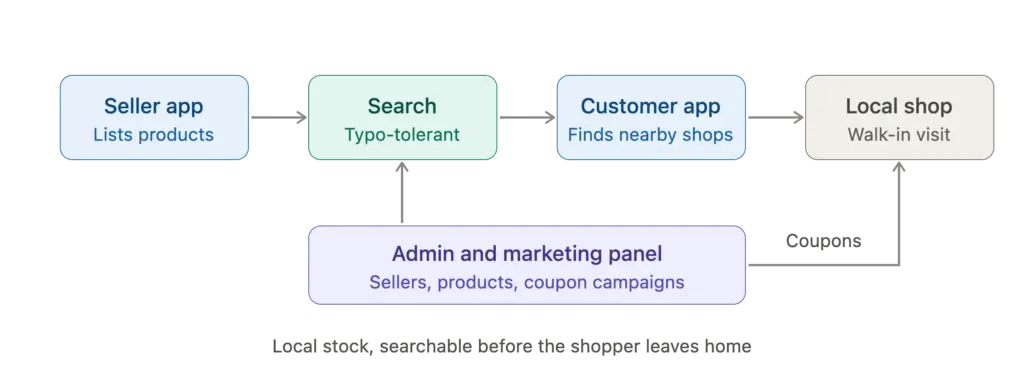
We delivered three connected parts: a customer app for Android and iOS, a seller app for shopkeepers and an admin and marketing panel to run the marketplace.
1. Customer app. Fast, typo-tolerant search across every listed shop. Results by product, category and shop. The search is Solr-powered.
2. Seller app. Shopkeepers register themselves with no manual setup. They list products in a few taps from a pre-built category library.
3. Admin and marketing panel. The operator controls sellers, products and categories, and creates and tracks coupon campaigns that drive walk-ins.
This is how we approach every project at Codiotic. We start with the real problem for each user, then build practical software around it. Explore our marketplace and custom software development services to see more of our work.
Why a hyperlocal marketplace helps local shops
The idea is not to replace local shopping. It is to make local shops easier to discover.
A hyperlocal marketplace helps in three ways.
● Shoppers know where to buy before stepping out. They search first, then visit the right shop.
● Shopkeepers get a free storefront. A digital presence without building their own website or app.
● Shops gain new walk-ins. Search and coupon campaigns send customers to the shop floor.
For the marketplace owner, the model also scales. It can grow city by city, with marketing tools built in from the start.
Inside the hyperlocal marketplace
01
Customer App
Search across all listed shops by product, category or shop name. Typos do not break the search. Available on Android and iOS.
02
Seller App
Shopkeepers self-onboard and list products in a few taps. A pre-built category library removes manual setup.
03
Admin and Marketing Panel
Control sellers, products and categories. Create and track coupon campaigns.
04
City-by-City Model
A scalable marketplace structure with built-in marketing levers, so each new city can launch on the same foundation.
Technology used in the hyperlocal marketplace
● Solr-powered, typo-tolerant search across shops, products and categories
● Customer app for Android and iOS
● Seller app with self-onboarding and a pre-built category library
● Admin and marketing panel with coupon campaign creation and tracking
Project outcomes
Shoppers know where to buy before stepping out
Customers can find which nearby shop has what they need, before leaving home.
Shopkeepers get a free storefront
Local sellers gain a digital presence and a chance to attract more walk-in customers.
A city-by-city model with built-in marketing levers
The marketplace can expand to new cities. Coupon campaigns give the operator a direct way to drive store visits.
Together, these results show how a hyperlocal marketplace can make local shops easier to discover without replacing the way people shop locally.
Browse more case studies, including our TrueRoots Supply case study, CEO Cabs case study and Buy Box repricing automation case study. See how we work with retail and e-commerce businesses, or talk to our team about your project.
Five lessons from building a hyperlocal marketplace
1. Let customers check before they go.
The core promise is simple: know what a shop has before stepping out. Everything in the product supports that one moment.
2. Make search forgiving.
Shoppers mistype product names. Typo-tolerant search means a small spelling error does not end the search. Fast, flexible search is what turns browsing into a shop visit.
3. Make seller onboarding effortless.
A marketplace is only useful when shops are listed. A hyperlocal marketplace depends on its supply side. Self-onboarding and a pre-built category library let shopkeepers list products in a few taps.
4. Use offers to drive walk-ins.
Admin-managed coupon campaigns give customers a reason to visit local stores, and give the operator a way to track what works.
5. Build for city-by-city growth.
A scalable model with marketing built in lets the marketplace expand one city at a time, without rebuilding.
Who needs a hyperlocal marketplace?
This approach suits:
● Businesses that want to connect local shoppers with nearby stores
● Marketplace owners planning to expand city by city
● Local shop communities that want an easy digital storefront
● Teams that need a customer app, a seller app and an admin panel as one system
A marketplace has two sides, and each side needs its own interface. When customers, sellers and operators all have a tool built for their task, the whole marketplace works better.
FAQ
What is City Bazaar Online?
City Bazaar Online is a hyperlocal marketplace built by Codiotic. It connects shoppers with nearby stores so they can check what local shops have before leaving home.
What is a hyperlocal marketplace?
A hyperlocal marketplace is an online platform that connects shoppers with shops in their own city or neighbourhood. It makes local stock searchable and helps bring customers to local stores.
What apps are included in the platform?
Three: a customer app on Android and iOS, a seller app for shopkeepers, and an admin and marketing panel.
How do shopkeepers join the marketplace?
Shopkeepers register themselves in the seller app with no manual setup. They list products in a few taps using a pre-built category library.
Who built City Bazaar Online?
Codiotic built it. Codiotic is a technology company that builds web and mobile applications, AI and automation solutions.
C
Want to Build a Marketplace?
Let's Talk.
Want to build a marketplace or a custom digital platform for your business? Discuss how Codiotic can turn your idea into something that works in the real world.
