 Skip to content

How Coding Agents Are Changing Custom Software Development in 2026
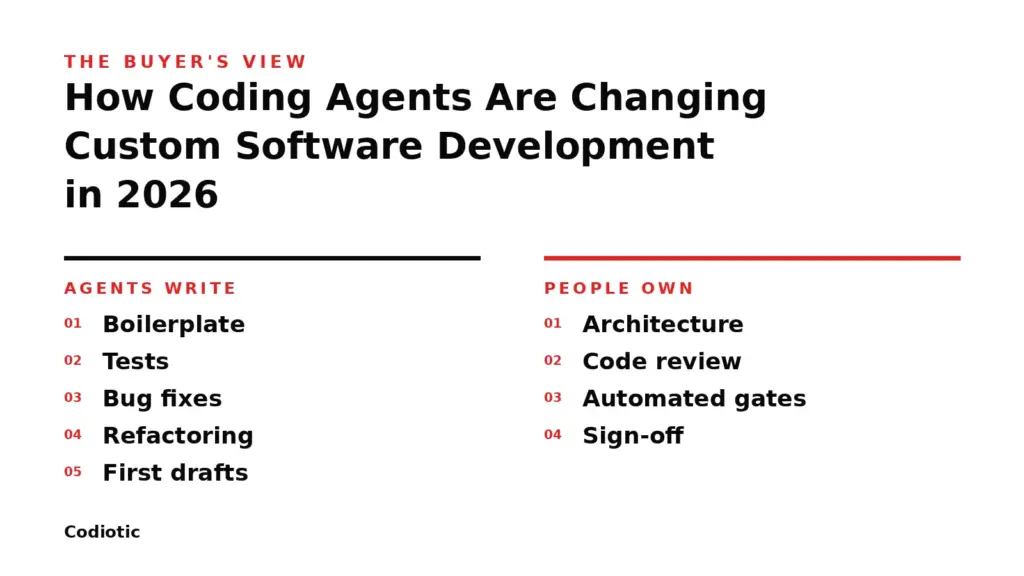
A year ago, most teams used AI to autocomplete a line or explain an error. Today, coding agents take a task, plan it, write the change, run the tests and open a pull request. Several can work at the same time.
If you commission custom software or SaaS, this matters to you even if you never open a code editor. It changes how fast work moves, where mistakes hide and what you should ask your development partner.
At Codiotic, we build custom software and use coding agents in our own delivery. This guide gives the buyer’s view: what coding agents do well, how delivery has to change, what can go wrong and which questions to ask.
Coding Agents Are Moving From Assistants to Teams
The shift is visible in the market:
- Parallel agents are now a product category. Meta acquired Conductor in November 2026. Conductor gives each agent its own isolated workspace so several can modify one codebase in parallel, for example one on the interface, one on bugs and one on tests. It supports agents including Claude Code, OpenAI’s Codex, Cursor and OpenCode.
- Model makers are designing for it. Google announced Gemini 4 Hydrogen on 12 November 2026, as a fast model for coding, research and agentic workflows. Google describes a setup where a heavier model coordinates and Hydrogen powers worker and verifier agents that build and test changes at the same time in isolated workspaces.
- The code volume is real. GitHub’s Octoverse 2026 report found that over 40% of pull requests in September were started by AI agents, up from 17% in March. Separately, GitHub says total Git activity rose from 218.2 billion to 473.3 billion events a month between September 2025 and August 2026.
- The infrastructure is bending to match. GitHub recorded 7.38 billion commits in September 2026, more than five times the total a year earlier, and it is rebuilding its Git infrastructure for agent-scale work.
One caution on vendor claims: benchmark tables come from the companies selling the models. Google’s own comparison, for example, shows Hydrogen trailing Claude Sonnet 5.5 on terminal-based coding. Judge tools on your own codebase, not on launch posts.
What Coding Agents Actually Do Well Today
Coding agents are strongest on work that is well defined, has clear tests and does not need deep business judgment. In practice that includes:
- Boilerplate and scaffolding: CRUD screens, forms, API endpoints and standard integrations.
- Test writing: unit tests and edge-case tests for existing code.
- Bug fixing with a clear reproduction: where a failing test points to the problem.
- Refactoring and migrations: repetitive, rule-based changes across many files.
- Documentation and code explanation: summaries of unfamiliar code for new team members.
- First drafts: a working version for a human to shape.
They are weaker where the problem is vague, the architecture is unsettled or the answer depends on knowing why the business works the way it does. Agents tend to produce something that works. Whether it is the right thing to build is still a human judgment.
How Custom Software Development Changes
When agents write a large share of the code, the bottleneck moves. Writing code gets cheaper and faster. Deciding, reviewing and verifying do not. Four parts of a custom development engagement change most.
1. Architecture and requirements become the main work
Agents amplify whatever direction they receive. A clear architecture, naming rules, data model and acceptance criteria produce coherent code. Vague direction produces plausible code that does not fit together.
Expect more time upfront on specifications, domain rules and system design, and less time on typing. The people who own architecture matter more, not less.
2. Code review becomes the main quality gate
More code arrives faster, and it still needs to be understood. A Help Net Security report on OX Security’s research found that AI-generated code is not necessarily more vulnerable per line than human code, but vulnerable systems now reach production faster than review can scale. OX describes the result as an “army of juniors” that produces large volumes of functional code and needs senior oversight.
Good teams respond by splitting work into small changes, requiring tests with every change and keeping a senior engineer accountable for what merges.
3. Testing and automation carry more weight
When a human writes code slowly, informal checks may be enough. When agents write it quickly, automated tests, linting, type checks and security scans become the safety net. A strong test suite is what lets you accept agent output with confidence. A weak one turns speed into risk.
4. Delivery becomes more incremental
Because small changes are cheap, teams can ship in smaller steps and show working software sooner. For clients, that means earlier demos, more frequent feedback and more chances to change direction. It also means you should expect to be involved more often, and to be able to say “not that, this.”
The Risks Buyers Should Understand
The evidence on quality is mixed, and honest buyers should hear both sides.
Quality and defects. CodeRabbit’s analysis of 470 open source pull requests found AI-generated pull requests averaged about 10.83 issues each, against 6.45 for human ones, roughly 1.7 times more. That is a small sample from one vendor, so treat it as a signal. A GitLab survey of DevOps practitioners found that more than a third of code is now written by AI, and practitioners rank quality control and AI-introduced security flaws as the top adoption challenges.
Security. Veracode reports that across more than 150 models, only 55% of AI-generated code passed basic security tests when no security guidance was given. The lesson is not “avoid agents.” It is that security rules, scanning and review must be built into the process.
Technical debt. Researchers have started studying whether AI-introduced debt is fixed or quietly accumulates. One large study covers five major AI coding assistants across more than 6,000 real GitHub repositories, because it is still unclear how this code ages. Plan for refactoring and ownership from the start.
Context limits. Agents work from the context they are given. On large or old codebases, they can miss conventions, duplicate logic or break distant parts of the system. Clear documentation and small, well-scoped tasks help.
Multi-agent coordination. Running agents in parallel only helps if their work can be merged and verified. As one analyst note on the Conductor deal observed, the effectiveness of this approach depends on how reliably the agents work together and how their output is reviewed.
Cost. Agent loops use many model calls. Read our guide on AI agent costs and what token bills hide before assuming that faster code always means a lower bill.
How Development Partners Should Adapt
A development partner using coding agents well will look different from one that does not. Look for:
- Senior ownership. A named architect or lead who owns design and signs off on every merge.
- Written standards. Coding conventions, architecture notes and security rules that agents are given as context.
- Test-first habits. Tests written or reviewed by humans before agents implement.
- Automated gates. Continuous integration, static analysis, dependency scanning and secret scanning on every change.
- Small, reviewable changes. No giant pull requests that nobody can read.
- Clear AI use policy. Which tools are used, what code or data they can see and what is never sent to them.
- Human accountability. Agents propose, people decide. Our guide to human-in-the-loop AI explains where to place approval and where sampling is enough.
For connected tooling, standards such as the Model Context Protocol are making it easier to give agents safe, controlled access to project tools and data. Access should still be least-privilege.
Questions to Ask Your Software Partner
Before you sign, ask:
- Which coding agents and models do you use, and for which tasks?
- Who reviews every change, and what is their seniority?
- What automated tests and security scans must pass before code merges?
- How do you protect our code and data when agents are involved?
- Who owns the architecture, and how is it documented?
- How do you measure quality, such as defects found after release and change failure rate, not only speed?
- How does AI use affect the price, timeline and scope, and who benefits from the savings?
- What happens if the tool or provider changes? Can we maintain the code without the agent?
- Who owns the intellectual property of agent-written code?
- How will you keep us involved in decisions, demos and acceptance?
A partner who answers specifically has changed how they work. A partner who answers with only “we use AI to go faster” has probably changed their marketing.
What Clients Gain If It Is Done Well
Used with discipline, coding agents can deliver real benefits to the buyer:
- Faster first versions, so you can test ideas with users sooner.
- More test coverage at lower cost.
- Lower cost for routine work, freeing budget for design and product thinking.
- Faster maintenance and upgrades, including repetitive migrations.
The gains come from the process around the agent, not the agent alone. Teams with weak review and weak tests simply produce more problems faster.
Key Takeaway: Agents Write More Code, People Own the Outcome
Coding agents are changing custom software development, and the change is already large. Code is cheaper to produce, so judgment, architecture, review and testing carry more of the value. The right question for a buyer is no longer “do you use AI?” It is “how do you keep what AI writes correct, secure and maintainable?”
How Codiotic Builds With Coding Agents
At Codiotic, we use coding agents inside a disciplined process: senior-owned architecture, written standards, test-first habits, automated security and quality gates, and human sign-off on every merge. We share what we use and why, so you stay in control of your product.
Explore our custom software and AI development services and our SaaS and product engineering work, or talk to Codiotic about your next build.
FAQ
What are coding agents?
Coding agents are AI tools that take a software task, plan it, write or change code, run tests and propose the result, often with little step-by-step prompting. Unlike autocomplete, they work across files and can run several tasks in parallel.
Will coding agents replace software developers?
Not in the way headlines suggest. Agents write more of the code, but architecture, requirements, review, security and accountability still need skilled people. The balance of work moves from typing code toward specifying, reviewing and verifying it.
Is AI-generated code safe for production?
It can be, with the right process. Studies are mixed. Some show more defects in AI-written code, while others find the main problem is the speed at which unreviewed code reaches production. Use automated tests, security scanning and senior human review on every change.
How do coding agents affect the cost and timeline of custom software?
They can lower the cost of routine work and shorten the time to a first version. Savings depend on the project and on the quality of review, testing and architecture. Ask your partner how AI use changes price, timeline and scope.
What should I ask a development partner about coding agents?
Ask which agents they use, who reviews every merge, what automated tests and security scans must pass, how your code and data are protected, who owns the architecture and intellectual property, and how quality is measured beyond speed.
