 Skip to content

Multilingual AI: Does It Really Work Beyond English?
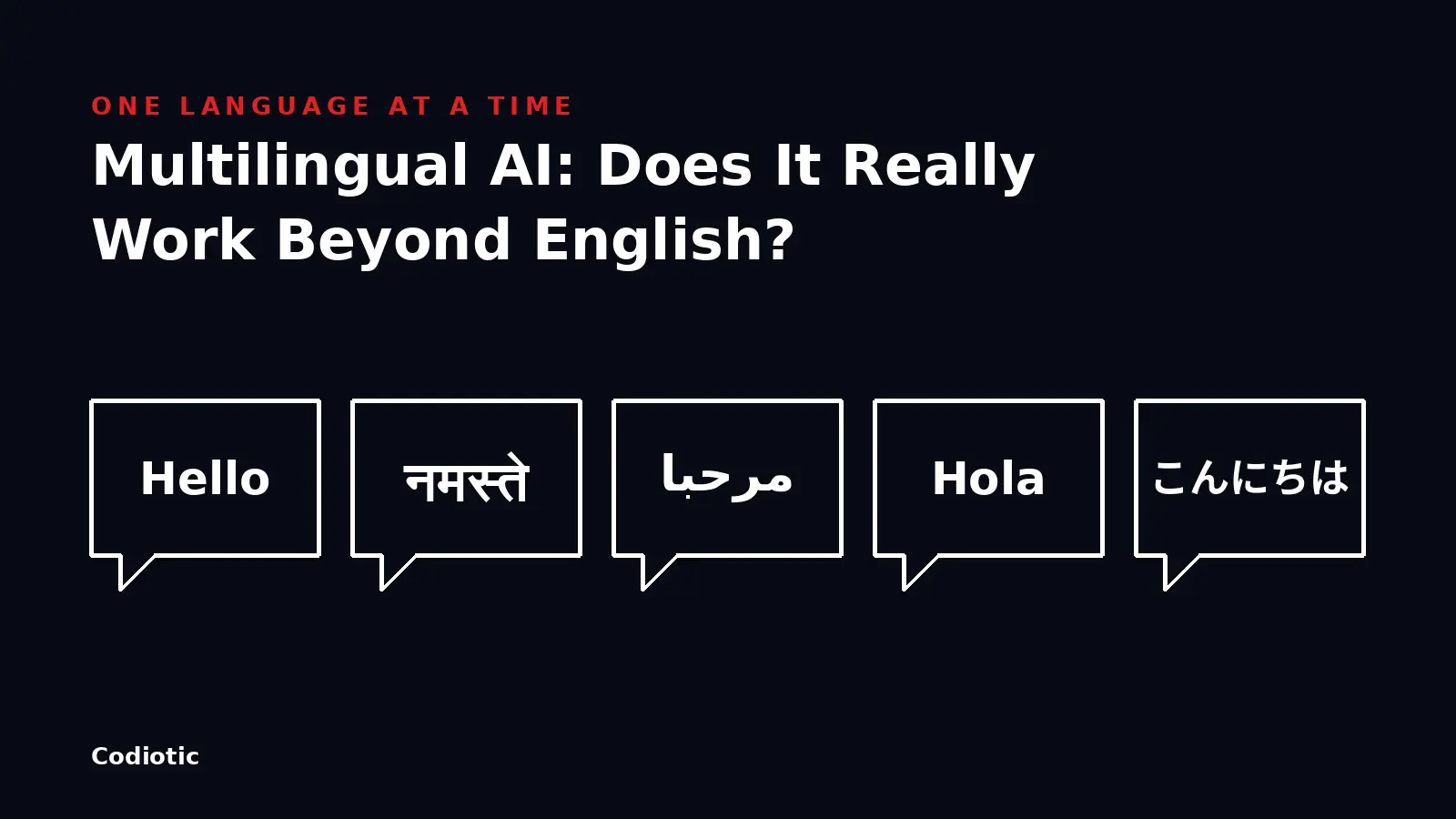
Your AI can speak multiple languages. But can it understand them equally well?
That distinction matters more than most teams realise. Most AI tools can generate responses in Hindi, Arabic, Spanish or Japanese. But multilingual AI capability does not automatically mean consistent quality, accuracy, cost or safety across languages.
At Codiotic, we build practical technology solutions for businesses, and we see the same pattern often: a promising demo in one language, then surprises in production in another. This guide explains five things every business should know about multilingual AI, followed by a simple way to test it before launch.
"It Speaks Hindi" Is Not the Same as "It Works in Hindi"
A model that produces fluent sentences has shown it can generate a language. It has not shown it can handle your support tickets, product names, tone of voice or compliance rules in that language.
Fluency is the easy part to see. Accuracy, consistency and safety are harder to see, and they are what customers feel. The useful question is not "which languages does the model support?" but "how well does our use case perform in each language we serve?"
1. Multilingual AI Quality Varies by Language
AI models generally perform better in English and other widely represented languages. Performance can drop in languages with less training data, particularly in translation and complex tasks.
In practice, a chatbot that answers English billing questions well may misread the same question in another language, or give an answer that is grammatical but wrong. Complex tasks, such as summarising a long complaint or following multi-step instructions, tend to expose the gap first.
A demo in one language tells you very little about the others.
2. Multilingual AI Can Cost More
Some models use more tokens to process the same message in certain languages. Tokens are the units a model reads and writes, and API pricing is based on them.
Two effects follow:
- Higher API costs for the same conversation.
- Less room in the context window, which holds instructions, history and any documents you supply.
With less room, an assistant may lose earlier parts of a conversation sooner. If you serve customers in several languages, budget per language rather than relying on one average.
3. Mixed-Language Conversations Are Challenging
Customers do not always communicate in one language. Messages that switch between Hindi and English (Hinglish), or Spanish and English (Spanglish), can expose weaknesses in AI systems.
Real messages also include spelling variations, local slang, abbreviations and sometimes more than one script in a single sentence. A system tested only on clean, textbook sentences may fail on the way people actually type on a phone. This is where multilingual AI often looks better in a demo than in production. Build your test set from real messages, not invented ones.
4. Safety Does Not Automatically Transfer
A model that performs well in English safety tests may behave differently in another language. Moderation, refusals and reliability need to be evaluated separately for each language.
This matters most where AI handles sensitive topics, customer data or regulated advice. If your assistant touches personal data, read our guide on questions to ask before building an AI workflow that touches customer data.
5. Benchmarks Do Not Tell the Whole Story
Many multilingual benchmarks rely on translated English test data. That can miss how people actually write and speak in each language, including local phrasing and cultural references.
Average scores can also hide significant gaps between individual languages. A strong average can sit on top of one weak language. Treat published results for multilingual AI as a starting point, not proof. Your own test set is better evidence.
The Good News: Multilingual AI Is Improving
Newer models are expanding language capabilities, and the gap is narrowing in many areas. But improvement does not remove the need to test. Businesses should validate actual performance rather than assume every language works equally well.
How to Test Multilingual AI Before You Deploy It
Before deploying a multilingual AI workflow, work through four checks.
1. Test each target language using real customer conversations
Collect real tickets, chats and emails in each language, with names and personal details removed. Include easy, hard and messy examples. You need enough samples to see patterns, not just one-off successes.
2. Have native speakers review the responses
Native reviewers should judge accuracy, tone and cultural context. A reply can be correct and still sound too formal, too casual or slightly off. Ask them to flag anything that could confuse or offend a customer.
3. Measure cost per conversation across languages
Track tokens, API spend and context use for each language. If one language costs noticeably more, you can shorten prompts, trim instructions or set a different budget for it.
4. Provide human support when the AI is uncertain
Define when the AI hands off: low confidence, repeated misunderstanding or high-stakes topics such as payments, complaints, and legal or health questions. Make the handoff easy, and make it in the customer's language.
A Simple Language Scorecard
Score each language you plan to support on six points:
- Accuracy: Are the answers correct?
- Tone: Does it sound right for your brand?
- Mixed language: Does it cope with Hinglish or Spanglish?
- Safety: Does moderation hold up?
- Cost: What is the cost per conversation?
- Handoff: Does a human step in when needed?
Launch only where a language passes. Languages that do not pass can start with human support or a narrower scope and be added later. If you are unsure which workflow to begin with, our AI workflow automation team can help you choose one that is easy to measure.
Common Mistakes With Multilingual AI
Launching every language at once. Add one at a time so problems are easy to trace.
Relying on translation alone. Translating English prompts and answers can lose meaning and tone. Test in the target language directly.
Ignoring local context. Dates, currencies, names and forms of address differ by market.
Skipping re-tests after updates. Model updates can change behaviour. Re-run your scorecard when the model, prompt or data changes. Skipped checks like these are one of the gaps behind why AI projects stall.
Takeaway: Verify Multilingual AI One Language at a Time
Multilingual support is not simply a feature you enable. It is a level of quality you need to verify, one language at a time.
How Codiotic Helps With Multilingual AI
At Codiotic, we build custom software and automation that is tested in the languages your customers actually use. We set up language-by-language evaluation, cost tracking and human handoff from the start, so quality is measured rather than assumed.
Using AI to talk to customers in more than one language? Talk to Codiotic and we will help you test it properly. You can also explore more at codiotic.com.
If your business uses AI to communicate with customers, which language has been the most challenging to get right?
FAQ
Does multilingual AI work equally well in every language?
No. AI models generally perform better in English and other widely represented languages. Performance can drop in languages with less training data, especially in translation and complex tasks. Test each language you plan to support.
Why does multilingual AI cost more in some languages?
Some models use more tokens to process the same message in certain languages. Since API pricing is based on tokens, costs can rise, and more of the context window is used. Measure cost per conversation for each language.
Can AI handle Hinglish or Spanglish?
Mixed-language messages can expose weaknesses in AI systems. Customers often switch languages mid-message, so test with real conversations that include mixed language, slang and spelling variations.
Is AI safety the same across languages?
Not automatically. A model that performs well in English safety tests may behave differently in another language. Moderation and reliability need to be evaluated separately for each language.
How do I test a multilingual AI workflow before launch?
Test each language with real customer conversations, have native speakers review accuracy, tone and cultural context, measure cost per conversation, and provide human support when the AI is uncertain, particularly for high-stakes interactions.
