 Skip to content

Vibe Coding vs Engineering: Code That Looks Right Is Not Code That Is Right
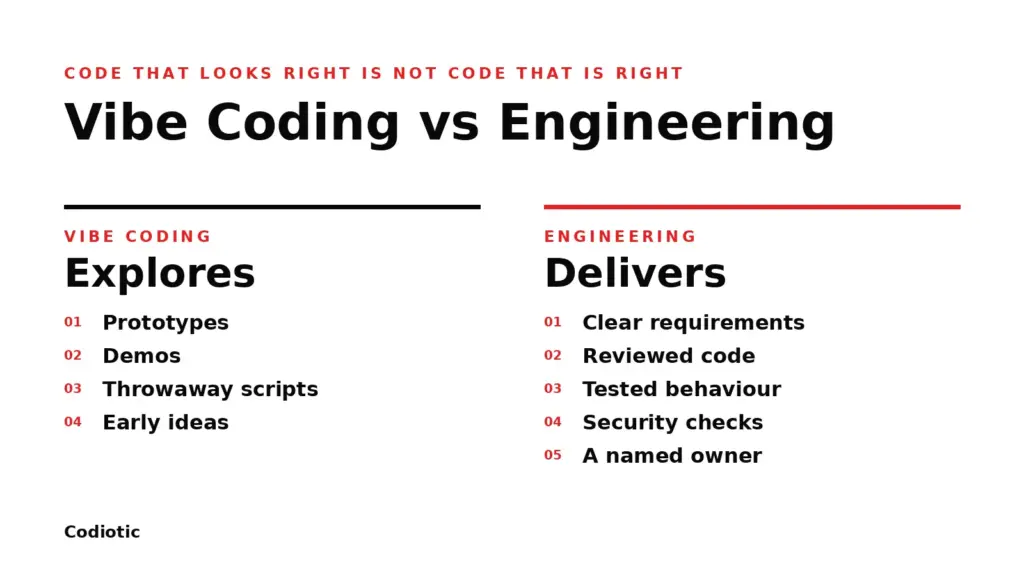
Code that looks right and code that is right are not the same thing. That is where vibe coding and engineering part ways.
In February 2025, Andrej Karpathy coined the term "vibe coding" for building software while focusing less on the code itself. Collins Dictionary later named it Word of the Year for 2025. It is a genuine shift in how software gets made.
But the evidence also shows its limits. At Codiotic, we build custom software and use AI heavily in our own delivery, so we see both sides. This guide looks at what vibe coding does well, what the security and productivity research actually says and what turns a fast prototype into dependable software.
What Vibe Coding Is, and Where It Shines
Vibe coding means describing what you want in plain language, letting an AI write the code and steering by results rather than by reading every line. It lowers the barrier to building and speeds up exploration.
It works well for:
- Prototypes and demos that need to exist by Friday.
- Throwaway scripts and one-off internal tools.
- Exploring an idea before you commit budget.
- Learning and experiments where nothing sensitive is at stake.
For these jobs, speed matters more than long-term reliability. The risk starts when a prototype quietly becomes a product.
Evidence 1: Security
Veracode's 2025 GenAI Code Security Report is the most cited test. It gave more than 100 large language models 80 coding tasks designed to expose common weaknesses, and found that in 45% of cases the models produced code with vulnerabilities from the OWASP Top 10. Cross-site scripting was a weak spot: 86% of samples failed to defend against it.
Read it carefully. This was a controlled benchmark in which models had to choose between secure and insecure implementations. The models tested were released between March 2023 and May 2025, and the study focused on four specific weakness types. It is not evidence that 45% of production AI code is vulnerable.
What it does show is a pattern worth respecting: working code and secure code are different properties. A feature can run perfectly in a demo and still leave a door open.
Evidence 2: Productivity
METR ran a randomised controlled trial that stands out for its realism. Sixteen experienced open-source developers completed 246 tasks in repositories they know well, with each task randomly assigned to allow or disallow AI.
The result surprised everyone. Developers forecast that AI would cut completion time by 24%, and afterwards estimated that it had cut it by 20%. In fact, tasks took 19% longer with AI.
The gap between belief and measurement is the important part. People can feel faster while moving slower, because prompting, waiting and reviewing feel like progress.
An important update
Be careful not to over-read this result. METR itself notes limits: the tools were from the February to June 2025 frontier, and the developers were experts in mature codebases. METR does not claim its developers or repositories represent most software development work.
In February 2026, METR published a follow-up. It reported that developers are likely more sped up by AI tools in early 2026 than in early 2025, but that selection effects obscure the true speedup, because developers who benefit most from AI were less willing to take part in a study that withheld it. For newly recruited developers, the measured effect was small and uncertain, with a range of -15% to +9%.
So the honest summary is: AI tools have likely improved, and the exact productivity gain is still hard to measure. The lasting lesson is the perception gap. Your team's sense of speed is not a measurement.
Why Code That Looks Right Fools Us
AI-generated code is usually tidy, well named and confident. It runs. It passes the demo. That is exactly why it fools reviewers.
What gets missed is rarely visible on the screen:
- Authentication and permissions that work for the happy path but not for a malicious user.
- Edge cases: empty inputs, duplicates, time zones, failed payments.
- Error handling: what happens when a service is slow or down.
- Data handling: where personal data is stored, logged or sent.
- Maintainability: structure that nobody can safely change six months later.
None of these show up in a quick test. They show up in production, usually at a bad time.
Vibe Coding vs Engineering at a Glance
Vibe codingEngineeringGoalMake it work and see itMake it dependable and keep it workingBest forPrototypes, experiments, throwaway toolsProducts with customers, money or personal dataChecks"Does it look right?"Requirements, review, tests, security scansOwnershipOften nobody after launchA named owner after launchFailure costLowCan be highMost real projects use both. The skill is knowing when to switch.
The Five Things Engineering Adds
AI can help you build faster. Engineering makes sure what you build can be trusted. Five practices make the difference.
1. Define requirements clearly
Write down what the software must do, for whom and what counts as done. Include limits, failure cases and who can see what. AI follows your direction, so unclear direction produces plausible but wrong software.
2. Review the generated code
Someone who understands the system should read what the AI wrote, especially code that touches money, logins or personal data. Small, reviewable changes work better than giant ones. Our guide to how coding agents change custom software development covers how review becomes the main quality gate.
3. Test the functionality
Automated tests turn "it seems to work" into "it works, and we will know if it stops." Test the normal path, the edge cases and the failure cases. Tests also let you change the code later without fear.
4. Address security risks
Add security scanning, dependency checks and secret detection to the build. Give the AI explicit security rules. Treat anything involving authentication, payments or customer data as high-risk and review it by hand. The Veracode result is a reminder that security does not appear by default.
5. Take ownership after launch
Software needs updates, monitoring, backups and fixes. Name an owner who is responsible for it. A prototype nobody owns becomes a liability. Where AI makes decisions inside the product, place people at the steps that matter, as we explain in human-in-the-loop AI.
If You Already Have a Vibe-Coded Prototype
Many founders arrive with something that works. Before you put customers on it, check:
- Does it store personal or payment data?
- Who can log in, and what can each user see or change?
- Are there automated tests?
- Is anything secret, such as keys or passwords, written in the code?
- Can anyone other than the original builder explain how it works?
- Is it backed up, monitored and updated?
If you cannot answer these, treat it as a prototype, not a product. A short engineering review can often turn it into something dependable without starting over.
Key Takeaway: Vibe Coding Explores, Engineering Delivers
Vibe coding is a fast way to explore an idea. Engineering is what makes that idea dependable: clear requirements, reviewed code, tested behaviour, addressed security risks and a named owner after launch. AI can help you build faster. Engineering makes sure what you build can be trusted.
How Codiotic Turns Fast Ideas Into Dependable Software
At Codiotic, we use AI to move quickly, then add the engineering that makes software safe to run: clear specifications, senior review, automated tests, security checks and ownership after launch. Whether you have an idea or a prototype that needs hardening, we can help.
Explore our custom software and AI development services and SaaS and product engineering, or talk to Codiotic about your build.
Where have you seen the difference between vibe coding and real engineering?
FAQ
What is vibe coding?
Vibe coding is building software by describing what you want to an AI and steering by results, while paying less attention to the code itself. Andrej Karpathy coined the term in February 2025, and Collins Dictionary named it Word of the Year for 2025.
Is vibe coding safe for production software?
Not on its own. Veracode's 2025 benchmark found that models introduced OWASP Top 10 vulnerabilities in 45% of test cases. That is a controlled test, not a production rate, but it shows security does not appear by default. Review, testing and security scanning are needed.
Does AI make developers faster?
It depends on the setting and the tools. METR's 2025 trial found experienced developers took 19% longer with AI, even though they believed it made them faster. METR's 2026 follow-up suggests newer tools likely help more, but the true speedup is hard to measure. Do not rely on perceived speed.
When is vibe coding a good idea?
It suits prototypes, demos, throwaway scripts and early exploration of an idea, where speed matters more than long-term reliability and no sensitive data is involved.
How do I turn a vibe-coded prototype into a real product?
Write clear requirements, have an experienced engineer review the code, add automated tests, run security checks, remove secrets from the code and name an owner for maintenance. A short engineering review can often harden a prototype without a full rebuild.
